
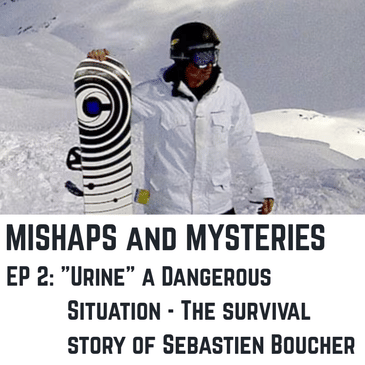
Winter 2012 at Cypress Mountain: a 33 year old snowboarder spent nearly 3 days in the frigid backcountry. The days navigating through heavy snow were harrowing for Sebastien Boucher. The rescue was a result of the hard work of volunteers and some sheer luck. An incredible story… with some controversy too.
Content Warnings: No content warnings
Of Particular Interest:
North Shore Rescue: Why We Don’t Charge for Rescues
Sources:
News Articles:
Snowboarder Recounts Tale of Survival After Spending 3 Days Stranded on Cypress Mountain Resort | CBC News
https://www.cbc.ca/news/canada/british-columbia/sebastien-boucher-cypress-1.3916150
Snowboarder Opts to Repay $10K for B.C. Mountain Rescue | CBC News
Man Rescued from Cypress Mountain Gives Big Donation to NSR | City News
Cypress Mountain to Bill Rescued Snowboarder | CTV News
https://www.ctvnews.ca/vancouver/article/cypress-mountain-to-bill-rescued-snowboarder/
Lost B.C. Snowboarder Ate Snow, Warmed Hands With Bag Full of Urine | Ottawa Citizen
https://ottawacitizen.com/news/canada/lost-snowboarder-ate-snow-warmed-hands-with-bag-full-of-urine
Helicopter Crew Finds Missing Snowboarder Alive in B.C. | CTV News
https://www.ctvnews.ca/canada/article/helicopter-crew-finds-missing-snowboarder-alive-in-bc/
Snowboarder Opts to Repay $10K for B.C. Mountain Rescue | CBC News
Out of Bounds Boarder Needs Rescue | North Shore News
https://www.nsnews.com/local-news/out-of-bounds-boarder-needs-rescue-2918183
B.C. Mountain Officials Says Rescued Snowboarder to Face Fine After Major Search | Global News
Stranded Snowboarder Cold, But No Major Injuries After 2 Days on North Shore Mountain | Times Colonist
Other:
Cypress Mountain Ski Area | Wikipedia
[00:00:00] - [Speaker 0]
Welcome back to mishaps and mysteries. I'm your host, Cassie.
[00:00:04] - [Speaker 1]
And I'm your host, Mina.
[00:00:06] - [Speaker 0]
Our podcast explores stories of misadventures in the wild landscapes of British Columbia, Canada. Episode two, you're in a dangerous Situation, the survival story of Sebastian Boucher.
[00:00:21] - [Speaker 1]
Today, we're looking at an amazing survival story. We're pulling you out of the summer heat and dropping you back in time onto the snowy and frigid slopes of the North Shore Mountains. It's Sunday, 12/16/2012 at Cypress Mountain Ski Resort in North Vancouver. A 33 year old snowboarder named Sebastian Boucher finds himself lost in a frozen alpine wilderness, all alone and with a dying cell phone.
[00:00:51] - [Speaker 0]
Cypress Mountain is one of three popular mountain resorts in the area. They tower above the Greater Vancouver region, blowing in the winter nights. Cypress is the westernmost of the three, but just because it's close to the most urban area in BC doesn't make it any less dangerous. Some history. In 1870, the first logging road was cut through to what would later be called Hollyburn Mountain.
[00:01:20] - [Speaker 0]
And by 1920, a ski club was established. And before the Lions Gate Bridge was constructed, skiers had to take a boat from Downtown Vancouver and actually hike up Hollyburn Bridge to ski the mountain. Today, Cypress's downhill runs are made up of two mountains, Mount Strachan and Black Mountain. And not only can you ski or snowboard there, but there is also cross country trails, snowshoeing, tubing, restaurants, and don't forget summer activities like hiking, scenic rides on the chair lifts, and the Eagle Coaster, which I would love
[00:01:55] - [Speaker 1]
to do one
[00:01:56] - [Speaker 0]
day. It gets over 1,000,000 visits a year and hosted freestyle skiing and snowboarding in the twenty ten Winter Olympics.
[00:02:04] - [Speaker 1]
Cass, you grew up with these mountains, didn't you?
[00:02:07] - [Speaker 0]
Yeah. I grew up on the Lower Mainland. As a teenager, I spent a lot of time snowboarding them, but I was more of a grouse girl myself. This story definitely takes me back. Shout out to my sister Trina, who is still a very avid snowboarder at Cyprus every winter.
[00:02:23] - [Speaker 0]
So back to Sebastian. On his way to the mountain early that morning, he learned that his best friend, Nick Vachon, had been hit by a car and killed back in Ottawa. He contemplates just turning around and going home after the devastating news, but decides to go boarding anyway because that's what Nick would want him to do. But the loss and grief are really affecting him while he's outboarding.
[00:02:48] - [Speaker 1]
It wasn't entirely clear from our research, but it does seem from some reports that he was on Cyprus with friends. However, he separates from them to do a run on his own. It seems that he went out of bounds figuring he knew the terrain. But distracted from the loss of his friend, he isn't paying attention and suddenly finds himself lost. Back home in Gatineau, Quebec, Sebastian was legendary, known as the Tasmanian devil on skates in his men's hockey league.
[00:03:16] - [Speaker 1]
He was an athlete and experienced at camping. At this point, he'd been working as a mortgage broker in Vancouver for about four years.
[00:03:25] - [Speaker 0]
He was well packed for a typical day on the slopes with snacks and such. Unfortunately, he had left his first aid kit in his car. And that food, well, it would run out quick when suddenly he needs it to survive. He had his phone in a ziplock bag to keep it dry while snowboarding, But he only managed one five second call to a friend to let them know that he was in trouble before that contact ended. Presumably, this was one of the friends that was on the mountain that day.
[00:03:56] - [Speaker 0]
As an aside, we also read that he placed a voicemail and a text message on Monday the following day. Was this to the same friend? Who was it to? We know it wasn't to 911 because a voicemail wouldn't be an outcome here. And texting 911 wasn't introduced in Canada until March 2014.
[00:04:16] - [Speaker 1]
Attempting to keep himself warm, he tried running in place and even tap dancing. He's on the move attempting to get to safety. He doesn't have any food or water. He's sucking on snow to try to hydrate. He says he thought about Nick a lot.
[00:04:32] - [Speaker 1]
Remember, he's still grieving and now he's in a high stakes survival scenario. He finally had to tell himself he needed to stop thinking about it because he needed to focus on staying alive. On Monday, the following day, he finds a spot that reminds him of a teepee like structure and uses it as a makeshift shelter. He tried starting a fire but couldn't. By Monday afternoon, there's 49 centimeters of new snow, which would make both his wanderings and a search for him extra challenging.
[00:05:05] - [Speaker 1]
You really have to put yourself there in your imagination to understand what he must have been going through.
[00:05:11] - [Speaker 0]
Okay. So we know he was sucking on snow. He built a makeshift shelter. He danced. Right?
[00:05:17] - [Speaker 0]
But also remember, he had his phone in a ziplock bag. He peed in the bag and used the warmth from the urine to combat the cold. He later said in an interview with the Ottawa Citizen, quote, that's the smartest thing I've ever done, pissing in a ziplock bag, end quote. Okay. We have
[00:05:37] - [Speaker 1]
to debunk the survival myth here. We've seen drinking urine in movies, and everyone thinks it's a hydration hack in a survival scenario. I think it was popularized by the movie 127, which is right up our alley as far as stories go. If you haven't seen it, check it out. But it's actually dangerous because of the salt and waste concentration.
[00:05:58] - [Speaker 1]
It'll dehydrate you and put strain on your kidneys. But as a heating pad, that's actually brilliant. It just goes to show you never know what you can use as a tool in a sudden need for survival.
[00:06:10] - [Speaker 0]
Meanwhile, two different search and rescue crews have been out searching for him in the treacherous terrain. They did spot some tracks. Again, we're on Monday now. But as the day went on, conditions like the increasing amount of snowfall and low cloud cover were impacting the search and helicopter usage. When nightfall came on Monday, they had to cease searching.
[00:06:34] - [Speaker 1]
On Tuesday morning, crews start searching again at first light. Conditions are better for now. The problem is there's a storm forecasted for that night. Crews know that they have to really make a strong push to find Sebastian before the storm renders searching impossible. Three helicopters and dozens of volunteers are on the mountain looking.
[00:06:56] - [Speaker 1]
Tuesday at noon, Sebastian's mom, stepdad, and some friends arrive at YVR having flown in from the Ottawa region after hearing the news that he is missing. With some more local friends meeting them at the Cypress parking lot, they all await good news together. There's about 10 of them. So he is certainly loved.
[00:07:16] - [Speaker 0]
And back to Sebastian. He's on the cold mountain slopes and is back on the move again. He, of course, doesn't know that there is a storm forecast for later that day. He wants to find a creek. In an attempt to get to flowing water, he had to climb down a practically vertical steep hill.
[00:07:35] - [Speaker 0]
It was down in a gully, which is essentially a steep trench carved by water over thousands of years. And you know what's interesting? He's still carrying his snowboard through all of this. I have to ask you, Nina, would you keep the board?
[00:07:51] - [Speaker 1]
It is extra weight and certainly very awkward, but it is a potential tool for digging or even for signaling. Tough call. Last episode, we did say to stay with your pack. So now Sebastian has been out in the winter cold and the deep heavy snow for over two days, and a lucky break comes. At 2PM, helicopter crews spot tracks in the snow and not even in the primary search area way outside of it.
[00:08:18] - [Speaker 1]
Bruce Moffitt's North Shore Rescue Search Manager said that he thought, if this
[00:08:24] - [Speaker 0]
is our guy, he's just been an Energizer bunny who's been going through some real tough stuff. Ground crews focus in. Sebastian figures he's hallucinating and thought he heard Johnny Cash music and begins calling for help. He definitely either got very lucky or he did indeed hear something because that's when he saw Flashlight way up above. Search and rescue worked their way to him with two teams coming towards him from either end of the creek.
[00:08:53] - [Speaker 0]
They reached him at about 6PM. That's how treacherous the terrain was. It took them four hours to get to him even when he was in sight. It was incredibly challenging for Cruz to get any movement forward over fallen trees and deep snow. This was near the Sea To Sky Highway and Howe Sound.
[00:09:13] - [Speaker 0]
So he had traveled down the west side of the mountain. He was outside of their primary search area. It was only because of the sightings of the tracks that they even knew to look there. It was basically a six kilometer straight line from where he first went out of bounds, and it was a thousand meters closer to sea level than when he went missing.
[00:09:32] - [Speaker 1]
It was clear from his condition that he needed to be airlifted out. It wasn't until 10PM that they were able to winch him out with a Royal Canadian Air Force cormorant helicopter. Winching and search and rescue is when a helicopter has a long mechanical cable that allows you to strap someone in while the helicopter hovers above. The cable then lifts the person to the helicopter, and they are carried to safety. In BC's mountainous terrain, this technique is not too uncommon.
[00:10:01] - [Speaker 1]
In Sebastian's case, the cable was extended a 100 meters down into that creek gully. Just after he was rescued into the helicopter, the weather got more dangerous. And instead of taking him directly to the hospital, they had to land at YVR Airport where an ambulance was waiting to take him to the hospital. In recollections of the story, it's said that he walked from the helicopter to the ambulance on his own.
[00:10:26] - [Speaker 0]
He had been in a lot of pain and had cuts and bruises. He had figured he lost consciousness over 20 times. He lost 18 pounds and had nerve damage to fingers and toes. But amazingly, he didn't even have hypothermia. He needed ten stitches, but other than that, he was released just hours later.
[00:10:48] - [Speaker 0]
Incredible given how long he was out there. He said he survived because of his physical fitness, and he clearly had a strong will to live. He had a pepperoni pizza at a hotel and went to sleep. Nina, what food would you want after surviving in the cold for nearly three days?
[00:11:05] - [Speaker 1]
Oh, I don't know. I think definitely something spicy, kind of curry. How about you, Cass?
[00:11:11] - [Speaker 0]
Definitely a hearty lasagna and some garlic bread. Awesome. So many factors had to come together for this positive outcome. One, the sheer force of will of both Sebastian and rescue crews. Two, the helicopter just happening to fly over where his tracks were even though he was outside of the primary search area.
[00:11:33] - [Speaker 0]
And three, the visibility and winter storm weather just happening to have a break on the Tuesday before the next storm hit, and it would have rendered helicopter sighting and helicopter rescue impossible. His mom and stepdad said his rescue was the best Christmas present they could have ever received.
[00:11:52] - [Speaker 1]
But the story doesn't end here. This case caused quite a bit of controversy as Cypress Mountain wanted to charge him for rescue and donate it to the North Shore Rescue. There was even an opinion piece written shortly after to the province newspaper about charging those who go out of bounds because it's their irresponsible choice that got them in trouble the first place. Jeffrey Coleman, who was the director of sales at Cypress Mountain at the time, said Sebastian Boucher made, quote, several mistakes, ignored warning signs, ventured into the backcountry alone, didn't stay in one spot, and didn't call for help in a timely manner, end quote. He said about 50 Cyprus staff of all kinds of positions were involved in this in searching for him, and $10,000 wouldn't even cover the full cost of the search.
[00:12:42] - [Speaker 0]
They did withdraw the bill, but worked with him on a campaign about going out of bounds. And he was very apologetic for the risk that he put others in. Search and rescue groups refused to charge, and the reasoning is, imagine you don't have $10,000. You're not gonna call, or you're going to call when you're in even more of a dangerous or time consuming rescue situation. It could put not just yourself in greater risk, but search and rescue volunteers.
[00:13:11] - [Speaker 0]
And the cost of your rescue may rise even greater if you delay calling. It may put your family and friends at risk too if they go searching for you in order to not incur costs. Search and rescue teams are volunteer based and always in need of more funding. Ultimately, taxpayers in BC do not pay much into search and rescue funding. If you ask us, it's more than worth it.
[00:13:34] - [Speaker 0]
Yes. People will make mistakes, and, yes, some of them may even be very blatantly stupid, but that doesn't mean we punish them for it when the risk can be death. The controversy, it had impacts. It led to misinformation about rescues with the $10,000 potential charge having been in the headlines. In August of the following year, a man bushwhacked for hours on Grouse Mountain.
[00:14:02] - [Speaker 0]
So the ski hill east of Cyprus, and asked search and rescue how to get back on track, but said he did not wanna search initiated because it would cost too much. This confused search and rescue. What do you guys think? Let us know on our socials if you think that search and rescue should come at a charge.
[00:14:19] - [Speaker 1]
But here's the amazing thing. Sebastian decided to raise the funds anyway. He held a fundraiser near Ottawa and raised the $10,000, which he donated to North Shore Rescue the following summer. He wrote in his blog at the time, here's a quote, it's vital to highlight and acknowledge one thing from those few days on Cypress Mountain, the North Shore search and rescue team. They risked their lives to save me, and for that, I owe them my life.
[00:14:45] - [Speaker 1]
They are true heroes, end quote. Truly a happy ending to this story. We here at mishaps and mysteries also can't say enough about the dedicated work of search and rescue teams across the province. Their work is invaluable. This podcast aims to highlight that with many of our stories to come.
[00:15:03] - [Speaker 0]
Yeah. I really admire that he went and raised the funds anyway. Shows you a lot of character. Sebastian, if you're listening, I'm sure your friend Nick would be so proud of you. This amazing survival story is a stark reminder that the mountains are dangerous.
[00:15:19] - [Speaker 0]
Days later, another couple of snowboarders went out of bounds on Cypress Mountain. One was able to call for help when he couldn't find his friend. Like Sebastian, he ended up down a gully, not far actually from where Sebastian was. Both were very apologetic. This time, the mountain did not threaten to charge as they were hardly involved in the search.
[00:15:42] - [Speaker 0]
Sebastian's story was then later referenced again three years later in 2016 when two snowshoers went missing in the same area on Christmas day. Chunsek Lam and Roy Tin Ho Lee went snowshoeing. This is another story in our case catalog that we plan to cover soon.
[00:16:01] - [Speaker 1]
For today's safety lesson, we have a few tips to share with you for your winter mountain adventures. Always stay in bounds. Call 911 if you're in trouble. Don't hesitate. 911 is how you get search and rescue initiated for those who don't know or say out of what would be the primary search area.
[00:16:22] - [Speaker 1]
Carry a fully charged phone, Ziploc bag optional. Keep your emergency kit on your person, not in the car. This isn't a part of the story. Wear your helmet on the mountain.
[00:16:34] - [Speaker 0]
Yeah. You know, Nina, I know that at least one time while snowboarding, my helmet absolutely saved my life. Thanks for joining us this episode. You can reach out to us at infomishapsandmysteries. Ca.
[00:16:48] - [Speaker 0]
If you enjoyed this episode, please subscribe and leave us a rating and a review. It really helps new people find us. Be safe and never stop exploring.