
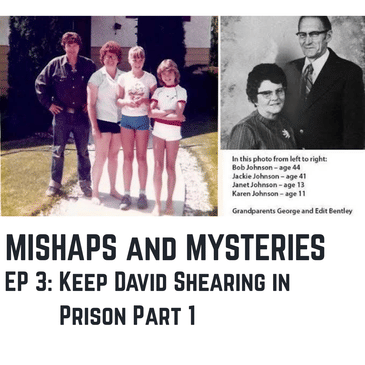
This episode covers one of British Columbia’s most shocking true crime cases: the disappearance and murder of six members of the Johnson-Bentley family during a camping trip in Wells Gray Provincial Park. It’s a devastating story about violence in a place associated with safety, nature, and family memories.
We also look at how the RCMP investigated the case before the digital age — from massive ground searches and public tip lines to the unusual decision to drive a replica of the family’s missing camper across Canada. The episode builds toward the identification of David Shearing and the ongoing push to keep him behind bars.
Content warning: murder, violence, child abuse, and references to pedophilia. Please listen with care.
Key Topics
[00:00:07] - Content warning and the episode’s heavy subject matter
[00:01:01] - The 1982 disappearance of the Johnson-Bentley family in Wells Gray Provincial Park
[00:03:14] - Why Wells Gray’s size and terrain made the search so difficult
[00:06:36] - Introducing the family: Edith, George, Jackie, Bob, Karen, and Janet
[00:08:37] - Bob fails to return to work and the missing persons report is filed
[00:09:34] - The burned car is discovered on Battle Mountain
[00:10:33] - Identification of the family remains and the first grim evidence
[00:11:17] - The replica truck-and-camper strategy and the flood of public tips
[00:13:13] - Discovery of the old Bear Creek campground and holdback evidence
[00:16:27] - Timeline recap and the lead-up to David Shearing being suspected
[00:18:48] - Cliffhanger ending and what part two will cover
[00:19:56] - Safety takeaway: There is no waiting period to report someone missing
Relevant Links
Change.org petition: https://www.change.org/p/parole-board-of-canada-keep-david-ennis-aka-david-shearing-convicted-mass-murderer-behind-bars-deny-parole?source_location=search
Wells Gray Provincial Park: https://bcparks.ca/wells-gray-park/
RCMP: https://www.rcmp-grc.gc.ca/
BC Parks: https://bcparks.ca/
Amazon Link to the book Murder Times Six: The True Story of the Wells Gray Murders: https://www.amazon.ca/Murder-Times-Six-Story-Murders/dp/1989980163
This case is a stark reminder of how quickly a missing-person situation can turn urgent, and why early reporting matters. The episode also raises difficult questions about justice, parole, and the long-term impact on victims’ families.
If someone feels “off” or out of character, report it right away — there is no 48-hour rule.
[00:00:00] - [Cassie]
Welcome back to mishaps and mysteries. I'm your host, Cassie.
[00:00:04] - [Nina]
And I'm your host, Nina.
[00:00:07] - [Cassie]
Our podcast explores stories of misadventures in the wild landscapes of British Columbia, Canada. This episode contains discussions of murder, violence, and pedophilia. It's a heavy story, so please take care of yourself when listening.
[00:00:24] - [Nina]
Episode three, keep David Shearing in prison part one. If you don't think monsters are real, we have news for you. Monsters walk among us, and this case is a stark reminder that you never know for sure if someone might be lurking in the shadows.
[00:00:42] - [Cassie]
Today's episode, well, we're covering a very heavy case. So right off the bat, let's give out content warnings. This case will include references to violence and murder. Discretion is advised. Please take care of yourself.
[00:01:01] - [Cassie]
Arguably, this is one of the worst true crime cases in British Columbia's history, and something about the backdrop of where it begins makes it particularly haunting. A multigenerational family camping trip in a large and beautiful provincial park. Camping is supposed to be a safe place. The shared vulnerability of it makes for an unspoken respect of each other's space and things. You can't lock up your tent after all.
[00:01:30] - [Cassie]
Yet, in 1982, that understanding of, or even rather illusion of safety was shattered after six family members camping near the small town of Clearwater BC were discovered to be missing and were later found dead. It's a case that really shocks the conscience. Very heavy reading.
[00:01:53] - [Nina]
Yeah. For sure. But you know what? I'm glad we're covering this now because there was just a petition to keep the killer behind bars. He's up for parole this August, and we should all be watching this case closely.
[00:02:06] - [Nina]
He has waived the parole panel option, and so it will just be a paper review instead. This denies the family and friends the chance to speak at a hearing. Cass and I were able to sign the petition when we were researching the case, but unfortunately, with the timing of our podcast launch, it has now closed. They were able to gather over 63,000 signatures. We wish them well, and we will keep you posted on the outcome.
[00:02:31] - [Cassie]
Yeah. It forces us to ask some deeply uncomfortable questions about how society handles the worst among us. We are looking at a collision between the idealistic framework of criminal rehab and the horror of what the killer did, as well as the enduring trauma inflicted on these victims' families. The law is designed with certain assumptions about human behavior, but when you apply those standard rules to a case of this magnitude, it just doesn't fit. This will be our first two part story.
[00:03:05] - [Cassie]
There's a lot to discuss, so let's get into this case.
[00:03:14] - [Nina]
It's August 1982, and your family members are missing. They have been off on a family camping trip. And as far as you know, they intended to meet at Wells Great Provincial Park in the Thompson, Okanagan region of BC. So the search begins in the park. It's a time before cell phones and no one knows what has happened to them.
[00:03:36] - [Nina]
But what they do know is something is wrong. Since we covered a story from another provincial park in our last episode, By comparison, Wells Gray is over twice the size of Strathcona Provincial Park. Established in November 1939, it's the fifth largest provincial park in BC at over 5,400 square kilometers of just pristine rugged wilderness, immense mountains, dense forest. It's known for its mineral springs, glaciers, alpine meadows, and particularly its waterfalls. Oh, it's massive and has areas with aggressively unforgiving terrain.
[00:04:18] - [Nina]
This is where the search began for the family.
[00:04:42] - [Cassie]
I've never been there, but I was looking at many photos while researching for this episode. And oh my, it's beautiful. I love the waterfalls. In fact, I saw it referred to as Canada's Waterfall Park. It has 42 named waterfalls within its boundaries.
[00:05:00] - [Cassie]
Most famously, Helmkin, which has a height of a 141 meters and is the fourth highest waterfall in Canada. Looks breathtaking and would love to camp here and check it out. And the park's natural beauty and range of activities is a big part of the economies in the area. Adventure tourism is hugely important here, And it was in the nineteen eighties too.
[00:05:26] - Cassie]
Have you ever been? Because listen, while a horrible tragedy took place here, it was an anomaly. Wrong place, wrong time, and a very bad person with a sick mind. The events of 1982 aren't a reflection of the safety of the area, both back then and now.
[00:05:45] - [Nina]
I did a rafting trip with a bunch of friends out of Clearwater, which was close to Wells Gray Provincial Park, but I've never been to Wells Gray Cast. We're gonna have to go there one day. But here's the here's the thing. I realized now I was actually probably close to the site of the murders on that rafting trip. See, while this case is famously called the Wells Gray murders, we know that the murder site was actually at a campsite near Phage Creek between Clearwater and Wells Gray.
[00:06:15] - [Nina]
It's often referred to as the Old Bear Creek Prison site where a low security prison had been abandoned. It was a quiet area with a nice clear space to set up. This family enjoyed quieter areas when camping. Though the fact that this was the site of their last days wasn't initially known. And for
[00:06:36] - [Cassie]
the Johnson Bentley family, this was supposed to be the perfect camping trip. Three generations just making memories and enjoying nature. We want to tell you more about these individuals. Edith and George Bentley, 59 and 66. Jackie, 41, and her husband Bob, 44.
[00:06:57] - [Cassie]
And Jackie and Bob's two daughters, Karen and Janet, 11 and 13. Grandma and grandpa, Edith and George, lived in Port Coquitlam and were avid campers. George had just recently retired, and they had just bought a new Ford truck and a new Vanguard camper for lots of camping adventures in their future. They were so excited to take it out for this two week camping trip with their family. The ultimate destination for the family was Jasper National Park in Alberta.
[00:07:29] - [Nina]
Bob and Jackie Johnson lived in West Kelowna with their two daughters. Jackie was the Bentley's daughter. They packed up their car, a Plymouth, and a tent. The girls slept in the tent while the adults slept in the camper. Bob was excited to tell his coworkers about the trip and looked forward to fishing.
[00:07:48] - [Nina]
The girls were so excited to be camping. Janet had just finished elementary school and would be starting high school in September. And Karen was going into grade six. The girls were described as bubbly and happy.
[00:08:01] - [Cassie]
Their dog Tyke was supposed to be there too, but had gone missing before their trip. The girls were asking about him and wishing that he was there to sleep in the tent with them and play with them. This is just a small fact, but kinda eats at me because he might have provided some protection or at least some comfort to the girls in what would happen next.
[00:08:23] - [Nina]
Yeah. The family wasn't even long into their trip before the the horror unfolded. At the end of their second day at the old Bear Creek site, violence drained down at the campsite out of nowhere.
[00:08:37] - [Cassie]
And the first indication that something had gone wrong actually came from mundane everyday life. Bob Johnson was this fiercely reliable employee at a local sawmill. He'd worked there for twenty five years. He was the kind of guy who once accidentally cut his finger off at work. And Nina, he showed up for his shift the next day.
[00:09:00] - [Cassie]
So when Bob didn't show up on August 16, and nobody could reach the family for a week, his boss finally filed a missing persons report on August 23. This initiated a search in an environment that is, as we said, just incredibly vast.
[00:09:17] - [Nina]
Yeah. Searching wells gray from the air or the ground must have been a logistical nightmare. I can't even imagine. The search party included RCMP, Clearwater residents, and private pilots. First, the RCMP had to figure out their last known location.
[00:09:34] - [Nina]
The first tip they got was from a gas station attendant who had pointed the Bentleys and the girls in the direction of some good berry picking. Edith loved to bake for family and friends, but that's the only tip they had to start. It wasn't until September 13, so a month from when Bob is due back to work, that fortunately, a local mushroom picker made a discovery on Battle Mountain, which is in the northern remote part of Wells Gray Park. He stumbled upon the Plymouth, the Johnson's car hidden deep in the bush, and it had been completely incinerated. Like the heat of the fire was so intense, it had actually melted the windows.
[00:10:16] - [Nina]
The tires were also melted. All this pointed to the fact that an accelerant must have been used.
[00:10:22] - [Cassie]
Wow. That's just insane. But they didn't just find the car. No. The RCMP investigators walked into something out of a nightmare.
[00:10:33] - [Cassie]
Because in the back seat, they found the ashes and bone fragments of four adults, and in the trunk, the remains of children. And this part is particularly tough to say, but one of those children's skulls had a clear bullet hole in it. This was a time before DNA was used in forensics, and the destruction was so absolute, they were essentially cremated. They actually had to rely on dental records and old x rays to identify them as members of the Johnson Bentley families. Ten days later, a funeral service was held for the family.
[00:11:10] - [Cassie]
But the family members and RCMP alike had no answers as to why such a thing had happened.
[00:11:17] - [Nina]
So at this point, RCMP have a mass murder on their hands, but they have no killer or killers, certainly no motive, nothing. They have no idea where the actual murders took place. And the Bentley's very distinctive new red and silver Ford truck and camper with the boat on top are still missing, which kicks off please to the public for any information. And they get it in the form of 13,000 tips. So one of the tactics the RCMP used here really jumped out at me from the sources.
[00:11:51] - [Nina]
They literally built an exact replica of the Bentley's missing truck and camper. They strapped an aluminum boat to the roof, painted at the exact same colors, and drove it all the way across the country to Montreal, all the way across Canada. They were holding press conferences along the way. The logic behind this was driven by a cluster of tips reporting sightings out east, specifically in places like Saskatchewan and Ontario. Witnesses claimed to have seen two scruffy French speaking men driving what looked identical to the missing camper.
[00:12:28] - [Cassie]
This part of the story is really wild to me. This definitely wouldn't be a tactic today in the age of the Internet. But if you place yourself in the investigative reality of 1982, there are no cell phone pinging towers, no GPS data in vehicles, no digital footprint at all, no financial transactions, a missing vehicle, which is basically your only piece of evidence. When multiple seemingly independent tips place a similar vehicle thousands of kilometers away, you have to run that lead to the ground. Yeah.
[00:13:01] - [Nina]
That makes sense. You have to exhaust the possibility that the killers are fleeing eastward when you've gotten what seemed like some pretty credible tips from out that way. The replica did work to learn of the last whereabouts of the family. Remember at this point, family and friends only knew that the family plan to meet at Wells Gray Park, and this is where the search had taken place. Seeing the replica triggered a tip about a similar looking setup at the old Bear Creek Prison site.
[00:13:32] - [Nina]
When officers check it out, there were a lot of signs that pointed to the family having been there, such as six camp chairs and Bob's favorite beer cans. Plus there were 22 caliber casings.
[00:13:45] - [Cassie]
That's so good that that information came from that. Though the replica tactic was not without its criticism either, we saw over and over again in our research the claim that this was the most expensive RCMP investigative search in Canadian history. And the dramatic irony is that a year later, two forestry workers finally locate the actual missing camper truck, and it wasn't in Ontario. It was on Trophy Mountain in Wells Gray, about 4,000 meters up in the very southern area of the park. Trophy Mountain today is known for its beautiful wildflower meadows and numerous hikes, and it's part of the Shu Swap Highlands.
[00:14:30] - [Cassie]
Its location is relatively close to the area where the family had originally vanished, right where searches began. And like the car, it had been driven deep into the bush and set on fire.
[00:14:44] - [Nina]
It was seen by forestry service workers, but they didn't report it for three weeks because they were up in their ranger cabin unaware of the news. Interestingly, somebody had recently planted tree seeds around the vehicle. There was a large reward out for finding the truck. So you think anyone else would report it rather than planting seeds. Was this an attempt to further hide the key evidence?
[00:15:08] - [Cassie]
The discovery of the campsite and the truck and camper provided something called holdback evidence. What is that? It's essentially the ultimate lie detector in a major investigation. It refers to specific details about a crime that only the perpetrator and the police could possibly know. In this case, there were two critical pieces of holdback evidence.
[00:15:34] - [Cassie]
First, with the discovery of the truck, investigators found a 22 caliber bullet hole in the door of the burned truck. And second, they didn't release to the public that they had found the shooting site at Old Bear Creek Prison Campground. So with this information in their back pocket, the RCMP start quietly re interviewing locals in the nearby town of Clearwater, and they were listening specifically for any mention of a bullet hole or Bear Creek. And I really want to pause on this concept, because it's fascinating how crucial this approach is when you are swimming in 13,000 random tips, and you know with a case this prominent in the headlines at the time, you're bound to get false confessions. A bizarre but very real phenomenon in the true crime world.
[00:16:27] - [Nina]
Oh, absolutely. It muddies the waters. By keeping specific facts secret, you can instantly verify if a suspect or a tip ster is credible. So let's do a quick timeline refresher. On 08/06/1982, the family plans to meet at Wells Gray Park.
[00:16:46] - [Nina]
On August 16, Bob fails to return to work. On August 23, the family's reported missing and the RCMP search begins. On September 13, the incinerated car and the bones of the family members are found on Battle Mountain. On September 23, a funeral service is held for the six family members. Between September 1982 and October 1983, the RCMP attempt to find the site of the murders, the missing truck and camper, and the killer were killers.
[00:17:22] - [Nina]
In October 1983, the Birch truck and the camper are found on Trophy Mountain. News goes out far and wide in Canada. Almost 1,500 kilometers away in the small town of Dawson Creek in Northern BC, an RCMP officer sits at the detachment with a man out on release following a traffic citation that turned into a violent incident. He has to check-in with an attachment weekly, and he always arrives on time. While going through the usual paperwork, the RCMP officers gets in use that the camper and the truck in the famous Johnson Bentley case has been found.
[00:18:03] - [Cassie]
The officer makes a remark about it. And the man, well, he actually pipes up about the discovery, and volunteered the fact that not only was he from the area, but just how close he grew up was to Trophy Mountain, and how he understood how dense the landscape was and how it would be difficult to spot the truck and camper in such terrain. The officer didn't know it then. No. But the RCMP would soon come to suspect that this very same man up in Dawson Creek was the monster behind the killings.
[00:18:39] - [Cassie]
His name, David Sheering. And his days of flying under the radar and living free were soon to come to an end.
[00:18:48] - [Nina]
But speaking of ends, we're going to leave on that cliffhanger today. In our next episode, we're going to cover how Sharing was caught, the details of the crime that only he could know, the trial, and what is happening today regarding this case. And while you'll certainly learn in part two why he should be kept behind bars, we would encourage you to sign the petition today. As mentioned at the beginning of this episode, this is currently a petition to keep David Sheering in prison as he's up for parole in August of twenty twenty six this year. Family and friends of the Johnson Bentley family are desperate to get enough signatures to appeal to the parole board to keep sharing where he is.
[00:19:37] - [Nina]
You could make a difference by signing this petition. Cass and I have already signed. He has waived the parole panel option, and so it will just be a paper review instead. This denies family and friends a chance to speak at a hearing. The link is in our show notes or you can go to change.org and look it up.
[00:19:56] - [Cassie]
As you may recall from our first episode, we said we would discuss potential takeaways for safety. Of course, the Johnson and Bentley family did nothing wrong. They were victims here. However, I can't help but wonder about the fact that it took a week for the families to be reported missing from when they were due back. We saw in the Sylvia Apps case that when she was not heard from on the day that she was expected, search and rescue was implemented right away.
[00:20:27] - [Nina]
This was of course a different time without the same ease of communication that we have today. But when Bob didn't shop for work with his impeccable attendance history, it could have been reported right away. A common misconception is that you have to wait forty eight hours to report someone missing. I actually think it is such a harmful misconception. If something feels off and is out of character and you are concerned, report it.
[00:20:54] - [Nina]
There is no minimum amount of time that has to have passed for you to report a loved one missing.
[00:21:01] - [Cassie]
Nina, being frequent True Crime consumers, you and I know that actually the sooner the better when trying to locate a missing person. In fact, those first twenty four to forty eight hours are the most critical for when the trail may still be hot. Thanks for joining us for this episode. You can reach out to us at info@mishapsandmysteries.ca. If you enjoyed this episode, please subscribe and leave us a rating and a review.
[00:21:29] - [Cassie]
It really helps new people find us. Be safe and never stop exploring.