
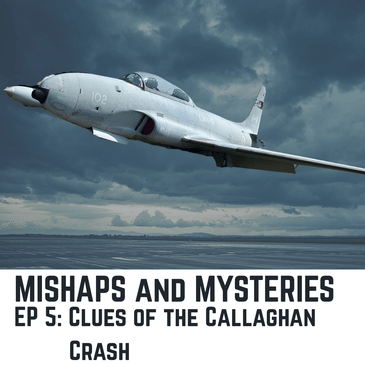
70 years ago, when tensions were high in the early cold war years, First Officers Stubbs and Miller took flight for a 90 minute, routine training flight. They were never seen again.
Over the decades, pieces of the crash have been discovered. But will we ever know what actually happened to the missing pilots?
Footnotes:
From our research we saw the names Olive and Claire for Gerald Stubb’s wife’s name – but given that her daughter Sally referred to her as Claire in recent news articles, we’ve referred to her the same. Maybe she went by Claire but Olive was her legal name.
There’s also reference to two other Stubbs children - Violet and Lucille, though we largely only saw references to Sally and Gerald aka Jerry, including in more recent articles.
We also saw discrepancies for the year the fuselage was found - either 1997 or 1998. 1997 seems to be the most consistently reported date.
Of Particular Interest:
Timeline:
1956: The pilots go missing after they lose communication early in their training flight.
1974: The canopy and plexiglass are found on a ridge of Mount Callaghan.
1997: The fuselage is found. It is examined but only tells us about possible improper fuel management.
2010: A helmet belonging to 409 Squadron is found.
Map of Debris: Google Earth image of the crash debris sites in this article by Whistler Museum
Sources:
News Articles:
Still Searching | Pique News Magazine
A Callaghan Mystery | Pique News Magazine
Settling Spirits in the Callaghan | Pique News Magazine
Other:
409 Tactical Fighter Squadron | Wikipedia
Cold War (1953 - 1962) | Wikipedia
Thursday 22 March 1956 | Aviation Safety Network
How Ejection Seats Work | How Stuff Works
Our Ghosts | Jo Ledingham Theatre Reviews
Callaghan Plane Crash | Hike in Whistler
Claire Stubbs | Earth’s Option Obituaries
Lockheed T-33 Silver Star | Canadian Museum of Flight
Miller, James Edward Alexander (Flying Officer) | CASPIR
Stubbs, Gerald Steven (Flying Officer) | CASPIR
Youtube Videos:
Pilots Missing For Over 50 Years - Callout Search and Rescue - Mystery Flight | Top Box TV
[00:00:00] - [Cass]
Welcome back to mishaps and mysteries. I'm your host, Cassie.
[00:00:04] - [Nina]
And I'm your host, Nina.
[00:00:07] - [Cass]
Our podcast explores stories of misadventures in the wild landscapes of British Columbia, Canada. Episode five, clues of the Callahan crash.
[00:00:20] - [Nina]
Seventy years ago, first officers Stubb and Miller take flight for a ninety minute routine training flight. They were never seen again.
[00:00:30] - [Cass]
At 09:58AM on 03/22/1956, first officer Gerald Stubbs, 32, and first officer James Miller, who was 24, take off from Royal Canadian Air Force Station Comox on Vancouver Island. They are from four zero nine Squadron, also called Nighthawks. The squadron fought in the second world war. And in the mid nineteen fifties, the RCAF station Comox was developing quickly. These were the early cold war years and tensions were high.
[00:01:09] - [Cass]
Four zero nine Nighthawk Squadron was reestablished at the Comox base because of its strategic location. They played a critical role in providing defense for the West Coast in the early Cold War years.
[00:01:22] - [Nina]
First officers Stubbs and Miller are on a routine instrument flying practice in a t 33 Silver Star, a military jet known commonly as the T Bird. The T Bird for a time was the most common two seat advanced training jet in the world and could reach up to 965 kilometers per hour.
[00:01:46] - [Cass]
Interestingly, the first prototype of this jet flew on 03/22/1948. So exactly eight years before that fateful day in Comox where our story starts today. The T Bird was used in the Royal Canadian Air Force from 1953 to 2005 and served a variety of military purposes. But they were also used in airshow performances, so you have likely seen them in that context.
[00:02:14] - [Nina]
It is foggy and turbulent that March morning. The training flight is only supposed to be about an hour and a half and take them within a 160 kilometer radius of Comox. The planned route was to fly northeast about a 110 kilometers and then make a sharp turn back for base. About seventeen to twenty minutes and approximately 24 kilometers into the flight, the radar shows that they've entered bad weather. Then air traffic control loses communication with the crew.
[00:02:47] - [Nina]
They weren't seen on radar after that. They weren't heard from again. They had disappeared. No one knew where they ended up after they encountered the bad weather.
[00:02:58] - [Cass]
There were witness accounts of a loud jet flying near Cortez Island, north of Comox by about 30 kilometers. For fifteen days, a search was carried out largely in the Cortez Island area. The assumption was that they had gone down in the ocean and had sunk, but nothing ever came from the searches. It remained a complete mystery until fall of nineteen seventy four, eighteen years later, when the canopy of the plane was found in an unexpected place, in the Callahan Valley near Whistler. No one ever searched out there.
[00:03:38] - [Nina]
Howard Road was an avid mountaineer and very familiar with the Callahan Valley, having hiked nearly every mountain. Someone in his hiking party spotted something on a ridge of Mount Callahan. Road went and had a look. It was a metal canopy and there was plexiglass from the windshield scattered throughout the area. He got the serial number and reported it when he got back.
[00:04:03] - [Nina]
It was matched to the missing plane from 1956.
[00:04:07] - [Cass]
The site of the canopy and windshield in the Callahan Valley was about a 125 kilometers east of Cortez Island. That's where the two week search had been focused. Let me tell you a bit about the area. The Callahan Valley sits in the Coast Mountain Range in the Squamish Lillooet region of Southern BC. It's made up of an ice field, old growth forest, snowy mountains, and alpine lakes, and a potentially active volcano.
[00:04:37] - [Cass]
This is grizzly territory, a beautiful wilderness just west of the resort municipality of Whistler. Mount Callahan, where the canopy was found, is approximately 26 kilometers from Whistler as the crow flies. It's a largely undeveloped area, but contains plenty of adventure tourism. It was the site of the Nordic events in the twenty ten Olympics and the Whistler Olympic Park, which is run today by the Whistler Sport Legacy nonprofit organization.
[00:05:09] - [Nina]
Following the find of the canopy, air force crews looked through the area but found nothing further. No other clues surfaced on the missing pilots until twenty three years later in 1997. A BC Forest Service firefighter, who was also a search and rescue volunteer sought from his plane. The discovery of the fuselage, which is the main part of the aircraft, was a major find. We saw different reports on our research, but it was found somewhere in the range of two to four kilometers south of the canopy and plexiglass near the Callahan Country Lodge, which still stands today and is only accessible by hiking or skiing.
[00:05:49] - Nina]
It's owned by Brad Sills, who we'll talk about in a bit here.
[00:05:54] - [Cass]
It did provide some more information. Examination of the fuselage by the directorate of flight safety was able to conclude that there was no mechanical failure. It was determined that the plane had crashed due to fuel starvation, quote, possibly by improper fuel management, end quote. The reason behind that fuel starvation remains unknown though. So with the locations of the fuselage and the canopy, an estimated trajectory can be made of the crash, and a search area can be honed.
[00:06:28] - [Cass]
You might be wondering, how were they so far apart? Two to four kilometers? That's a huge distance. Well, the fuselage find confirms that the pilots ejected from the plane. And understanding how ejection works helps to explain why there was such a distance between the pieces of the plane found so far in our story today.
[00:06:50] - [Nina]
Ejecting from a jet is really crazy. It's highly complex and very very quick, an engineering feat. We've watched videos of it and it's really mind blowing. It's also incredibly dangerous.
[00:07:04] - [Cass]
Yeah. I'm really amazed by it. Tell us how it works.
[00:07:07] - [Nina]
Only in the most serious of situations can it ever be used. When a pilot has no other option but to get out of the machine immediately for their safety, do they eject? So there's typically a lever or handle that a pilot will pull to eject. Then the canopy of the plane separates and flies off. The seats are a complex piece of equipment.
[00:07:30] - [Nina]
The pilot is restrained into the seat in a secure position and released from the jet. The seat also contains a survival kit. There's a quick rocket blast that literally comes from the seat to propel it out of and away from the jet. Then a parachute will be deployed that's attached to the chair. Then after they hit a certain altitude, a main parachute deploys and something called the seat man separator motor will have the seat released away from the pilot.
[00:08:02] - [Nina]
Then a typical parachute landing finishes the process. This all happens in a matter of a few seconds.
[00:08:09] - [Cass]
Remember, these jets can travel at speeds of hundreds of kilometers per hour. And then you add in the speed at which the seat is propelling in an ejection scenario, and the amount of force on the body is immense, and the risk is inherently very high. That's why it can only be used in the rare circumstance that it's really the only option. So with all that in mind, picture first officers Stubbs and Miller back in 1956. Something leads them to the very serious decision to eject.
[00:08:44] - [Cass]
The canopy comes off first and falls to the ground. The seats with the pilots restrained in them are next, and the jet carries on without them, eventually crashing into the subalpine environment below Mount Callahan and Ring Mountain. Investigators now have two pieces of evidence to tell them the trajectory of the flight. But where are the seats, parachutes, and the missing pilots? We know from the ejection process that the seats must be somewhere between the canopy and the fuselage.
[00:09:18] - [Cass]
Did the pilots both survive the ejection? It was assumed given the trajectory that the seats might be in Lake Callahan and possibly the bodies too.
[00:09:30] - [Nina]
But in October 2010, a new discovery proved otherwise. Two employees at the Callahan Country Lodge, Evan Boland and Christine Leppenin, find one of the pilot's helmets while out hiking. It was identified as belonging to four zero nine Squadron because of its coloring. This confirmed that the pilots had not gone down in a lake. And since 2010, Whistler Search and Rescue has done yearly grid searches in the area, usually along with the RCMP and private citizens.
[00:10:00] - [Nina]
They use it as training. In 2012, a TV show named Call Out Search and Rescue aired an episode about the missing pilots in the Callahan Valley. They followed Search and Rescue on the annual search and also interviewed Evan and Kirsty about finding the helmet in 2010.
[00:10:19] - [Cass]
Brad Sales, who is not only the owner of the aforementioned Callahan Country Lodge, but also the manager of Whistler Search and Rescue, helps with organizing the annual search and has a passion for the story and for finding answers. Brad has long been a key player in the Callahan Valley area, exploring it over many decades. And he's been recognized for his contributions to the Whistler community through his long career as a Tsar volunteer. He has a memory from the seventies when he was scouting routes for cross country skiing and he came across a makeshift camp. He remembers the camp contained tin sardines and a lot of cord, as in parachute cord.
[00:11:06] - [Cass]
He didn't think much of it at the time and thought it might be an old miners camp. But after learning about the missing pilots and the crashed t bird, that cord really stands out. But unfortunately, he can't remember the exact whereabouts of this camp. He does remember it being near a water course, but beyond that, he's got nothing. Yet the memory of that site and his desire to find answers for the Stubbs and Miller families keeps him going back on the search year after year.
[00:11:36] - [Nina]
No further clues have been revealed by the Callahan Valley. What ultimately happened to first officers Gerald Stumps and James Miller remains unknown. Wisdom Museum has the pieces of the helmet as well as a couple other items supposed to be from the crash, a piece of metal tubing and a piece of the windshield.
[00:12:02] - [Cass]
The disappearance of the pilots had lasting impacts in the decades that have followed, and we wanna share what we can with you. James Miller was married to Mary and they had two daughters, Michelle and Marilyn, only 20 and four months at the time. They were so young. We know that Mary later remarried and moved to Terrace. Not much else is known about the Miller family.
[00:12:26] - [Cass]
Claire Stubbs, Gerald's wife, spent her life waiting for Gerald. She never remarried. She wouldn't accept for a long time that he was dead. She quote, was convinced he was up somewhere in the wilderness wandering around with amnesia, end quote.
[00:12:43] - [Nina]
First officer Stubbs loved his job and was a family man. They lived on the Comox base. He also had a young family. Daughter Sally Stubbs was 18 old when they disappeared, and Claire was six months pregnant. She had a baby boy months after his disappearance and named him Gerald after his father.
[00:13:01] - [Nina]
They called him Jerry for short.
[00:13:03] - [Cass]
She eventually had to leave the housing on base with Gerald's disappearance. In the context of this being the late nineteen fifties, becoming a widowed mother would have been extra challenging. There wasn't daycares, and she couldn't even take out her own mortgage without a man to cosign for her. She had to move back to Winnipeg, Manitoba to be near her parents for support. She worked very hard to be able to provide for her kids, And eventually, she moved back to Vancouver Island and was actually able to purchase her own home in Victoria.
[00:13:36] - Nina]
In 2015, daughter Sally Stubbs told Peak News Magazine that Claire had, quote, accepted finally that he's dead. Her only hope now, at 89 years old, is that her ashes can be laid with him and that they can be together again after all these years, end quote. Claire passed two years after the article was written. In 2017 at 91. She spent nearly forty years trying to get information.
[00:14:05] - Nina]
She asked her daughter Sally to spread her rashes where they finally find you. Sally Stubbs is a playwright and educator in Vancouver now, and she wrote a play called our ghosts about her mother, Clara's life spent searching for her husband. It was released 03/22/2023, the sixty seven year anniversary of the crash. It was a beautiful tribute to her mother's story of never giving up and finding her loving husband. So what are the theories on what happened to the pilots?
[00:14:40] - [Nina]
Well, there's a lot. What caused the crash? The main theories are weather and machine failure. Windy, rainy weather and fog. That's nothing unusual for the West Coast, and the pilots were trying to fly in all kinds of weather.
[00:14:55] - [Nina]
So some feel that could not be the explanation. But remember, they did lose contact when they encountered the rough weather on the radar. They made
[00:15:04] - [Cass]
it so much further than where it was thought they went down. They kept flying long after they lost communication. As you recall, the air force thought that they had gone down near Cortez Island, about 30 kilometers north of Comox, But the jet actually went down a 144 kilometers from the Comox base. Were they on their way back? What would the protocol have been after losing communication?
[00:15:32] - [Cass]
For the machine failure theory, there was no indication that anything had gone wrong other than fuel starvation. But what was the improper fuel management that led to that? Was the wrong fuel used, not enough in the tanks, or switching tanks too late? We will likely never know now.
[00:15:51] - [Nina]
Was it a combination of both improper fuel management and poor weather with a loss of communication, maybe an unfortunate mix of these circumstances? We know that the pilots ejected, but what came from that? Finding the helmets proves they didn't land and drown in Lake Callahan, but with no seats or bodies found, can we guess they made it to ground and moved around eventually losing or parting with the helmet? The helmet could have also been dragged by wildlife over time to where it had been found.
[00:16:24] - [Cass]
And while it's just a memory, Brad Sills recollection of a rudimentary camp with a parachute cord is significant. Maybe one of or both of the pilots had in fact survived the initial escape from the plane and attempted to survive with what they could. It would have still been very cold and snowy in late March in the mountains. Thinking of them out there not knowing if anyone was coming is upsetting. Seventy years ago, without modern technology and with a search happening elsewhere, what were their chances of surviving out in the cold wilderness?
[00:17:01] - [Cass]
It's a good question.
[00:17:02] - [Nina]
Let's go over the timeline. 1956, the pilots go missing. In 1974, the canopy and plexiglass are found up on a ridge. In 1997, the fuselage is spotted. It is examined, but only tells us about possible and proper fuel management.
[00:17:23] - [Nina]
And in 2010, the helmet is found. It has ultimately been regular everyday searching by locals that has led to the pieces of this mystery being discovered. It was the hikers of Howard Roads Group back in the nineteen seventies that found the canopy and plexiglass, the local BC fire service pilot that spotted the fuselage, and the Callahan Country Lodge caretakers that found the helmet. The yearly searches by Brad Sills and his search and rescue crews show people's passion for helping to get answers, and that is so meaningful.
[00:17:57] - [Cass]
The average amount of years between new clues is about eighteen. So if the ballet is choosing to release her secrets every so often, we are hopefully due for a new clue soon. We will likely never know exactly what happened now that caused the crash. But maybe one day in the near future, the Miller and Stubbs families will get some peace and lay their loved ones to rest. We will certainly update you if any new clues surface.
[00:18:28] - [Nina]
This was our fifth episode. Yeah. If you've been listening along and enjoying our stories, please remember to subscribe and share with your friends. The best way you can help us is spreading the word so we can gain more subscribers. It's just the two of us.
[00:18:45] - [Nina]
We are doing all of our own research, writing, editing, social media, and so on, and are working really hard to bring you lots of great stories.
[00:18:54] - [Cass]
Also, don't be afraid to give us constructive feedback. We'd love to hear from you about any ways that we can improve. Your support means a lot to us, and it means that we can keep going. Be safe and never stop exploring.