
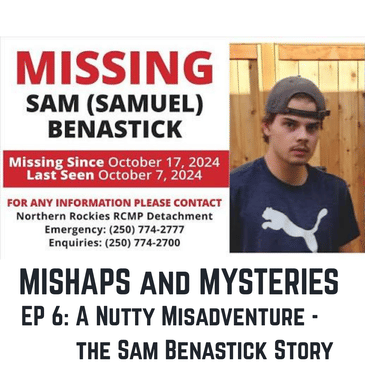
In late November 2024, headlines around the world thrust a remote and sparsely populated area of the Northern Rockies into the spotlight. A young man was missing and conditions had become cold and wintery.
He was presumed dead by many. Until, to much delightful surprise, he emerged from the wilderness, weeks after his disappearance.
Of Particular Interest:
Link to Wikipedia Article on the Muskwa-Kechika Management Area
Wolves and Humans:
Timeline:
October 7: Sam sleeps in car at trailhead
October 8: Last communication with family
October 9: Leaves car and uses dirt bike to ride towards Redfern lake. Doesn't get all the way there. Sets up camp
October 10: Decides from the wet conditions to turn back for his car. Plans to set up camp as it gets too dark to carry on. Followed by wolf.
October 11: First full day of disorientation, realizes he can't get his bearings
October 17: Trip is set to end
October 18: His mom is worried and the family sets out to start the drive to go look for him.
October 19: They arrive, go to the trailhead and find his car. Spoke to some people who hadn’t seen him. He’s reported missing
[Alternate reporting: October 20, Dad and Brother arrive in Pink Mountain. Mom arrives October 21]
October 21: RCMP put out statement about Sam
October 28: Search called off
November 11: Sam's family goes home to Kamloops
November 26: Sam is found
November 29: Sam is out of hospital
Sources:
News Articles:
Hiker Who Survived 50 Days in Northeast B.C. Woods Released From Hospital | CBC News
RCMP Narrow Search for Missing Hiker, Seeking Public Assistance | Energetic City
2 Separate Searches Launched for 2 Missing Men in Northeast B.C. | CBC News
Volunteers from Okanagan, Kamloops Come Home as Search for Missing Hiker ‘Paused’ | Kelowna Now
Search for Missing Redfern Keily Park Hiker Paused | Energetic CIty
Missing Hiker Found Alive After More Than Five Weeks in Wilderness | BBC
Other:
Redfern-Keily Provincial Park | Wikipedia
Redfern Trail | Recreation Sites and Trails BC
Pink Mountain, British Columbia | Wikipedia
Muskwa-Kechika Management Area | Wikipedia
Redfern-Keily Provincial Park | BC Spaces for Nature
Are Wolves Dangerous to Humans | International Wolf Center
Do Wolves Pose a Danger to Humans? | Wild Ireland
Youtube videos:
Missing Hiker Found Alive After More Than 5 Weeks in B.C. Backcountry | CBC News
Hiker Missing for 7 Weeks Found Safe in Canada’s Northern Rockies | Today
Missing Hiker Found After Surviving More Than a Month in Canada | ABC 7 Chicago
Weird - Hiker Survived 50 Days in Canadian Wilderness - Or Did He? | TheOutdoorGearReview
[00:00:00] - [Nina]
Welcome back to mishaps and mysteries. I'm your host, Nina.
[00:00:04] - [Cassie]
And I'm your host, Cassie.
[00:00:07] - [Nina]
Our podcast explores stories of misadventures in the wild landscapes of British Columbia, Canada. Episode six, A Nutty Misadventure, The Sam Benistick Story.
[00:00:21] - [Cassie]
In November 2024, headlines around the world thrust a remote and sparsely populated area of the Northern Rockies into the spotlight. A young man missing as conditions became increasingly cold and wintery was presumed dead by many. Until, to much delightful surprise, he emerged from the wilderness weeks after his disappearance.
[00:00:48] - Nina]
Today, we're covering another amazing story of survival. Our last few episodes have been pretty heavy, so it's nice to have an episode with a positive outcome.
[00:00:59] - [Cassie]
Yeah. Definitely a welcome change.
[00:01:02] - [Nina]
Our story center around wild spaces in BC, and it doesn't get much more remote than where we are taking you for today's story. We've spent a lot of time in Southwest BC so far, but you know where we haven't been? North. And today, we're going way north. In the Peace River region sits the Northern Rocky Mountains.
[00:01:25] - [Nina]
They're both gentle hills and large steep mountains. Picture bright blue pristine glacier fed lakes. There are very little populations of people dotted around and a lot of oil and gas industry up there and a lot of wilderness.
[00:01:42] - [Cassie]
And here sits Redfern Keely Provincial Park, established in June 1999, so quite recent. It's 80,000 plus hectares known for Red Fern Lake, which is a long narrow lake with bright blue colors. The park is made up of alpine tundra, glacially impacted landscapes, and rugged mountains of the Northern Rockies. There's no statistics on visits here because it's so remote. There's no directions on Google.
[00:02:10] - [Cassie]
But I'll tell you how to get there. You get to it by driving over 200 kilometers from Fort St. John on the Alaska Highway, and then following a dirt road for about another 18 kilometers to the trailhead. It contains grizzlies, black bears, wolves, caribou, elk, sheep, and of course, loads more wildlife. Hunting is popular here as well as camping, dirt biking, boating, snowmobiling, and river rafting.
[00:02:41] - [Cassie]
It's largely only accessible by off road vehicles or even horseback. Seriously, if you like playing around on Google Maps to check out new places, you should do it for this story. In the satellite layer, the gorgeous bright blue of Redfern Lake will really catch your eye even if you're quite zoomed out.
[00:02:59] - [Nina]
This is really cool. It's part of a much larger tract of land that is 6,400,000 hectares. That's twice the size of Vancouver Island. The Musquawat Ketchikka management area is provincially managed and even has an advisory board. There are different areas that have different levels of protection.
[00:03:18] - [Nina]
It contains 14 provincial parks and two ecological reserves. The nearest community to Redfern Keely is Pink Mountain, which is an unincorporated community of about a 100 residents. It's roughly 80 kilometers from where the story begins.
[00:03:34] - [Cassie]
20 year old Sam Benastic is from Kamloops and loves hockey, skiing, and adventures. He's just recently come back from a trip to Europe. He's young and I imagine he's got the travel bug. He's feeling a bit of an itch for another adventure because his mom, Sandra Crocker, would later see in interviews that he seemed listless after returning from Europe. So in mid September, he announces to his family that he's going to head out on a camping adventure in Redfern Keely Provincial Park.
[00:04:05] - [Cassie]
He has experience with these kinds of adventures, camping in remote places, and he really enjoys the outdoors. Problems with his car delayed his departure from Kamloops to the Northern Rockies. But on 10/07/2024, Sam does finally arrive at the trailhead for Redfern Lake Trail. He's planned for a ten day solo trip. His mother was worried about the trip, but he, quote, reassured her that there was lots of hunters and hikers in the area should he run into trouble, end quote.
[00:04:38] - [Nina]
At 80 kilometers long, the Redfern Lake Trail is for the adventurous. It's partially managed by BC Parks and partially by the Northland Trailblazers snowmobile club and the Moose ATV club. Trail maintenance remains basic though, and it can be quite rough and muddy. Sam camps for two nights in his car at the Redfern Lake Trailhead. On the eighth, so the day after he arrived and parked at the trailhead, he checked in with his family.
[00:05:06] - [Nina]
He then takes off on the trail for Redfern Lake on the morning of October 9. He's on a red Honda dirt bike he borrowed from his mother. Remember the trail is used by off road decals. And some notable items he has with him include a couple of tarps, a big black and red 85 liter Osprey brand backpack, fishing gear, a hatchet, warm hiking clothes, rain gear, and, quote, a lot of peanut butter.
[00:05:36] - [Cassie]
Days pass, and his parents at home in Kamloops wait to hear from Sam on October 17. It's been ten days since his trip and that's how long it was supposed to last. But they hear nothing. Now this next part is a little unclear. We saw two versions of what happened next.
[00:05:57] - [Cassie]
First, on October 18, his mom is worried and she, Sam's dad John, and brother Joe set out to do the twelve plus hour drive up to Redfern Cayley to look for him. They arrive at the trailhead on October 19, find his car, speak to some people who haven't seen him, and subsequently report him missing. Second version, he's reported missing on October 19 before any of the family arrive to the Northern Rockies. On October 20, John and Joe arrive to stay at the Buffalo Inn in Pink Mountain and Sandra arrives the next day, October 21. Either way, we know that on October 19, he was reported missing two days after he was set to end his trip.
[00:06:46] - [Nina]
Search and rescue teams arrived to the park. They include North Peace, Prince George, Salmon Arm, Kamloops, and Fort Nelson. There were more than a 120 search and rescue volunteers working to find Sam, and they amassed more than 3,500 search hours. Search crews included ground search teams, ATV teams, search dogs, and UAVs. There are also air force search and rescue helicopters, RCMP personnel, rangers, and local residents out searching.
[00:07:18] - [Nina]
We even read that some local sawmill employees were given time off to help search, but we couldn't find a name.
[00:07:26] - [Cassie]
Sam's family posted on local Facebook groups for hunters and fishermen in the area in the hopes of getting clues. Each day they were out searching with crews during daylight and sleeping at the Buffalo Inn in Pink Mountain at night. The weather here is very unpredictable, especially this time of the year. You can get relatively warm weather above zero Celsius with sun or rain one day and minus 20 with snow and wind chill the next. Cell service here is little to nil.
[00:08:00] - [Speaker 1]
I was actually surprised that Sam was able to be in touch with his family while sleeping in his car at the trailhead.
[00:08:06] - [Nina]
Crews searched hundreds of square kilometers. There were only a couple of glimmers of hope. They found tire tracks that could match the Honda dirt bike Sam was known to be on, and there was a possible sighting of Sam driving on the Alaska Highway reported by a truck driver. Yet searches came up empty handed. On October 28, so nine days after Sam was reported missing, the search was called off.
[00:08:32] - [Nina]
Sam's family stayed in Pink Mountain and continued searching for him every day in the park until eventually leaving on November 11. So about three and a half weeks from when they first arrived in the area to look for Sam.
[00:08:47] - [Cassie]
I can't imagine how scared and worried they must have been and the stress one must be under when looking for their child like that. It would have been a really difficult decision to leave the area and go home. But just like search crews, they would have had to weigh the likelihood of ever finding Sam alive with the now frequent freezing temperatures and snowfall. Though we did read that they never gave up hope. I saw in one of the articles I was reading a caption under a photo that listed the source as GoFundMe.
[00:09:20] - [Cassie]
And I looked into that further. They raised over $42,000 The money was to go to hotel, campsites, fuel, food for the crew, and volunteers. And any money that would be left would be donated to search and rescue. That's reasonable. The parents and brother have to travel up there, take time off work to look for him, and stay at the Buffalo Inn.
[00:09:46] - [Cassie]
I couldn't find out if there were any funds available after the Crocker and Donastic family left Pink Mountain that would have subsequently been donated to search and rescue.
[00:09:56] - [Nina]
Okay. Fast forward to 11:30AM on November 26. Standing on the side of a dirt road is a man, eerily without fecal or other people, just alone. A strange sight out here in the middle of nowhere. He has a hiking pole in each hand, and he is on the verge of collapsing as he flags down a truck with two men.
[00:10:22] - [Nina]
After the site registers to him, one of the men in the truck, Gaston Schafer, knows right away exactly who this must be. The missing young man whose picture has been everywhere in the region lately. The mystery man is wearing a cut up sleeping bag wrapped around his legs for warmth. He had a large backpack on and a light jacket. He had gloves that were looking rough and dirty, and he looked exhausted and weak.
[00:10:51] - [Cassie]
And yes, incredibly. Gaston was right. This was indeed samponastic. They must have been so shocked and surprised, but also really excited. Like, imagine you just happened upon a missing person.
[00:11:07] - [Cassie]
Everyone has presumed dead at this point. Even though you don't know him personally, it's a very powerful moment. They offered him some of their food, and he seemed to have trouble swallowing.
[00:11:19] - [Nina]
The second man in the truck is John Tatrey. John offered Sam some of his food. When they were able to get service, the men arranged to take him halfway to Fort Nelson, the nearest community with the hospital. At the halfway point, an ambulance would be there to take Sam the rest of the way. Fort Nelson would have been nearly a two hour, 180 kilometer drive north once they got to the Alaska Highway from the dirt road he was found on.
[00:11:47] - [Nina]
John also managed to get the number for John Bonastic, Sam's dad, and called him about Sam. John Bonastic seemed shocked. He then called back ten minutes later to ask to hear Sam's voice. He wanted to make sure it wasn't a prank, something I'm sure they had to deal with when he was missing, unfortunately. Sam made it to Fort Nelson General Hospital and stayed there.
[00:12:10] - [Cassie]
The story gained international attention with headlines like, hiker who survived fifty days in Northeast BC woods released from hospital, and missing hiker found alive after more than five weeks in the wilderness. It was a tragedy turned good news story, and survival stories like this always spark curiosity and capture the imagination. The survival of Sam captivated people far and wide. The situation sounded like something out of a movie. Nina, I was following this in the headlines at the time.
[00:12:45] - [Cassie]
Three days after being found, November 29, Sam was released from hospital. And personally, I know I was checking in on this story. I was one of those captivated people. I wanted to hear what happened, what he had to say. I thought, surely, there's going to be new articles out any day now with interviews detailing his experience.
[00:13:08] - [Cassie]
And I checked and I waited and I waited and I checked. As of writing this episode in summer twenty twenty six, Sam has not spoken with any media about his experience. We'll get more into this later.
[00:13:22] - [Nina]
Let's go over what we were able to piece together from our research. We'll have a simpler full timeline written out in our show notes for you too, so you can check those out too. The sequence of events by Sam's accounts are as follows. On October 9, he left his car and used the dirt bike to ride towards Redfern Lake. He didn't make it all the way there, so he set up camp for the night.
[00:13:47] - [Nina]
The next day, he came to the very smart decision that the conditions were too wet and turns back for his car, presumably to end the trip and head home. We know too that he didn't expect conditions in the park to be quite so difficult.
[00:14:01] - [Cassie]
But he's not gonna make it all the way back to his car at the trailhead by nightfall. So he plans to camp for the night. It seems he parked his dirt bike on the trail or somewhere nearby and then walked down to a creek to camp by it. But it's at this time that he's being followed by a wolf. He eventually got the wolf to back off somehow with a hatchet.
[00:14:25] - [Cassie]
His bear spray unfortunately didn't end up working. Trying to create further distance from himself and the wolf, he injured himself falling into a gully after the attack. He got a sprained ankle and a deep cut from this. He then set up camp for the night.
[00:14:42] - [Nina]
Having been fully focused on the wolf chase, he realized next morning for certain that he was now disoriented as to where he had come from and couldn't get back to his dirt bike. He camped Creekside for about ten to fifteen days and tried to care for his injured ankle and his wounds. He didn't feel he could travel far with the state that his legs were in. So he focused on healing. He used fishing line to sew up a wound when he ran out of materials in his first aid kit.
[00:15:13] - [Nina]
He made friends with a mouse that stayed in the shelter with him, but then it died. He didn't eat it and he didn't wanna be there anymore after its death. After that, as the weather worsened, he moved again further down to the valley to a dried out creek bed and set up a shelter there.
[00:15:31] - [Cassie]
Sam was surviving mainly on peanut butter. We said at the beginning of the episode that he had set out with a lot of peanut butter. He apparently rationed seven scoops a day. Of course, for the first however many days, he would have had food that he had packed for his ten day trip. But the large amount of PB he had brought was his main food source.
[00:15:54] - [Speaker 1]
Though we also read that he specifically had three potatoes to eat and he had fishing gear as we know, but he didn't manage to catch any fish. He did manage to catch and eat a bird. He stayed put until he was running out of his peanut butter and he knew he had to set out. So he started a journey east hoping to eventually hit the Alaska Highway. He walked for five days in the snow and the cold.
[00:16:22] - [Nina]
We did read from Gaston and John's accounts of talking to Sam in the truck that he, quote, found shelter in an old well site where a collapsed steel culvert offered some protection, end quote. This part is a little unclear. It seemed that he thought that he had hallucinated, which, yeah, that seems likely in the conditions he was living under. In that supposed hallucination, he thought he saw snowmobile tracks and pivoted his direction to follow those instead of carrying on directly east. But he couldn't find a snowmobile.
[00:16:56] - [Nina]
But he did find a plow trail from that either a wheel site or hallucination, whatever it was, and follow the plow trail until coming across Gaston and John. And that's the best we could put together of Sam's time alone in the wilderness. He asked for privacy. He hasn't spoken to any media. The RCMP shared little information and then said they were closing the file as there was no criminal element.
[00:17:22] - [Cassie]
Okay, Nina. When I set out researching this story, I thought this is an incredible survival story, and he hasn't talked much. Maybe Sam must just be very private. I can absolutely relate to that and respect that. Online, there was lots of chatter expressing skepticism about Sam's story.
[00:17:42] - [Cassie]
First, there was the matter of how he looked. We know from photos of Sam before his ordeal what he looks like, and it didn't appear that he had lost too much weight. There was a photo of Sam in the Globe and Mail with the men that found him. I hate to say it, but he doesn't look the way you would expect someone who's been surviving in the wild to look. You would expect that he would have lost a lot of weight and be gaunt, even with the peanut butter.
[00:18:09] - [Cassie]
But maybe he was managing just enough calories. PB is quite calorie dense food, but the calories you'd be burning just trying to stay warm, let alone doing anything else, are huge. Another point was helicopters. Timber Bigfoot, who is the land and environment manager of the Prophet River First Nation, was asked to help with search and rescue crews because of his familiarity with the area, which is in the Prophet River First Nation territory. He said that he didn't know how Sam could have missed the search volunteers even if the area is so remote.
[00:18:47] - [Nina]
In an area so isolated, what do you think of if I ask you to imagine how it sounds? Quiet. Right? So you would have think he would have noticed the helicopters. He would have heard them.
[00:19:01] - [Nina]
They went up and down the ranges according to Timber. And Timber also had lots of questions about how Sam managed to survive in those frequently freezing temperatures.
[00:19:12] - [Cassie]
Another main reason for the doubt was the wolf chase. Wolves are actually generally known to be wary of humans and keep their distance. They're biologically not interested in us as a food source. This is crazy, but between 02/2020, so eighteen years, there was only one known fatal wolf attack in Canada. It's incredibly rare.
[00:19:40] - [Cassie]
By comparison, there are about one to two fatal bear attacks per year. Circumstances that might lead to a wolf attack are rabies. This is the most common one. Being too exposed to human food sources such as landfills and farms. Becoming too comfortable near humans.
[00:19:59] - [Cassie]
This is called habituation, and it is often the result of humans encroaching on wolves' environments or physical condition or provocation. So there certainly is a possibility that, however rare, that a wolf was after Sam. If you ever encounter a wolf in the wild, always treat it with the respect that you would treat any wild predatory animal.
[00:20:22] - [Nina]
After he was found, many commentators online thought it was a fake, a stunt or a hoax. But, well, what would the point of that be? He doesn't seem to want attention. Neither he nor his family have spoken to anyone. Some have speculated at a book deal in the future, but that's all just the online gossip mill.
[00:20:43] - [Nina]
Sam not speaking publicly about how he survived brings up a debate here. Should survivors who have been searched for by search and rescue volunteers, community members, and public services like RCMP and rangers share what happened? Do they owe the public answers? Let us know in the comments what your opinion is on this.
[00:21:05] - [Cassie]
Personally, what bothers me more is that he also hasn't spoken privately with search and rescue who say they would absolutely respect confidentiality. But with survival anomalies like this, they like to learn from the survivor. They look a lot at statistics to justify how they search and being able to talk to someone who would be considered an outlier, they may gain some very valuable insights. And yet, he hasn't spoken to them. These people dedicate themselves and risk their safety to rescue others.
[00:21:38] - [Cassie]
And many volunteer hours were spent here. Hopefully, they can learn from Sam soon.
[00:21:44] - [Nina]
Lacasse, I have a lot of questions too. I think everyone is immensely curious for more details. But how sad is it that after surviving such a situation that you come back to a reality where people doubt you? Sam was young, healthy, and clearly resilient, managing to survive for weeks in the wild. Sam, if you're listening and ever wanna come on the podcast, we would certainly love to have you and share your story in whatever capacity you are comfortable.
[00:22:15] - [Cassie]
As we typically do for most episodes, we're gonna go over some safety tips. There's a lot that we could discuss, but let's keep it to a couple specific tips from this story. Always research the area where you are going and know about weather patterns. Hack for the unexpected. According to his mother, Sam had left his warm down jacket at home for this trip.
[00:22:39] - [Nina]
Carry a satellite communicator, especially in an area like this for a trip of such a length. Sam's story is recent, not quite two years old. So there's plenty on the market these days. And while they may seem expensive, they can potentially save your life. Look, Cass, I have a lot of questions too.
[00:22:59] - [Nina]
I think everyone is immensely curious for more details. But how sad is it that after surviving such a situation that you come back to reality where people doubt you? Sam was young, healthy, and clearly resilient, managing to survive for weeks in the wild. We say none of your things have happened. Sam, if you're listening and ever wanna come on the podcast, we would certainly love to have you and hear your story in whatever capacity you are comfortable.
[00:23:26] - [Cassie]
Sam was strong and creative in his survival situation. He fought to survive despite the circumstances using what he had, like fishing line for his wounds and sleeping bag pieces as layers. He didn't give up. He seems to have thought things through to the best he could, like waiting until his legs were doing better before moving again and rationing his peanut butter before heading east. From our warm, cozy safety, we can only imagine how tough daily life was when he was lost, how challenging some of these decisions must have been, and what it takes to fight to stay alive all alone out in the vast Northern Rockies.
[00:24:07] - [Nina]
Thanks for joining us for this episode. You can reach out to us at info@mishapsandmysteries.ca. If you enjoyed this episode, please subscribe and leave us a rating and a review. It really helps new people find us. Be safe and never stop exploring!