
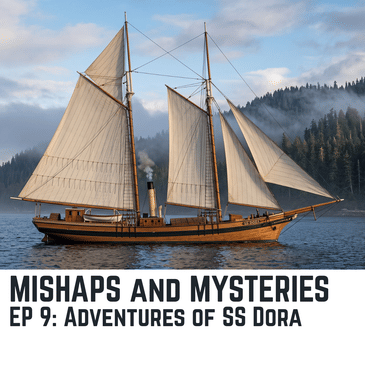
Today, we're telling you about a notable figure.
She was brave and bold and held jobs in the fur trade, the cod industry, helped move gold in the prospecting days and had many stories of rescuing hundreds of people and quite a few misadventures herself.
This is the story of Dora
Of Particular Interest:
What remains of Dora:
Dora | Heritage BC
Book about a photographer’s time on Dora”
https://clayworkspotters.com/thwaites/sailing.html
Book about SS Farallon Shipwreck:
https://www.indigo.ca/products/farallon
The Novarupta
The Great Eruption of 1912 | National Park Service USA
Sources:
About Us | Underwater Archaeological Society of British Columbia
Dora | Heritage BC
Report on the Salmon Fisheries in Alaska, Issue 909 | Google Books
Alaska Shipwrecks | AlaskaShipwrecks.com
SS Dora 1880 | Wikipedia
Katmai National Park & Reserve | National Park Service USA
The Great Eruption of 1912 | National Park Service USA
Archbishop of Vancouver Island Murdered Near Nulato | Aunt Phil’s Trunk
Sailing the Mail in Alaska | Clay Works Potters
[00:00:00] - [Cassie]
Today, we're telling you about a notable figure. She was brave and bold and held jobs in the fur trade, the cod industry, helped move gold in the prospecting days, and had many stories of rescuing hundreds of people and quite a few misadventures herself. Her name was Dora, and she unfortunately only lived forty years, but had an immense amount of influence in that time. In her short life, she lived large even though her stature was small. She left behind a legacy that endures today.
[00:00:39] - [Cassie]
So much so that she has had several places named after her. A couple of islands, a lake, a bay, and an ocean passage. Dora chose her final resting place to be near the North End Of Vancouver Island. And if you are a diver, you can visit what remains of Dora today on the ocean floor. Because Dora was not a person.
[00:01:04] - [Cassie]
Dora was a steamship. This is episode nine, adventures of SS Dora. Welcome to mishaps and mysteries. I'm your host, Cassie.
[00:01:16] - [Nina]
And I'm your host, Nina. Our podcast explore stories of misadventures in the wild landscapes of British Columbia, Canada. Thanks for being here with us today. We've explored quite a few places so far in our show. Today, for the first time, we are taking you out to sea.
[00:01:33] - [Nina]
Our long coastline is such an important part of British Columbia culture and history. It's been important for the movement of people and goods for all the time that humans have inhabited the coast. Now the Essaes Dora, the main character of our story today, was largely a figure of Alaska in its time. Grab your life jacket. We're setting sail into one of
[00:01:53] - [Cassie]
the coast's greatest maritime tales. SS Dora was built by Matthew Turner, who was a prolific ship designer and builder, and a famous sea captain based out of the shipyards near San Francisco in the eighteen hundreds. In fact, he took the prize for building the most ships out of anyone at the time, and was often credited as being the granddaddy of wooden shipbuilding in the Pacific. Made with special Puget Sound pine, the steamship Dora was 34 meters long and eight meters wide or a 112 feet by 27 feet. Just a note that while we typically use the metric system in our stories, we're going to generally share the imperial metrics too in this story because we hope that we'll have some of our Alaskan and Washingtonian neighbors listening.
[00:02:42] - [Cassie]
So the propulsion methods used for the Dora were sails and a compound single screw engine, which was run by steam from the boiler. The boiler used about 3,000 pounds of coal a day. 04/07/1880, the Dora set sail for the first time, launched from the shipyard at Benicia, California in the San Francisco Bay Area. On board for the inaugural sale were 18 steamship veterans from Alaska. They, quote, enjoyed an elegant cold lunch and drinks in her tapestry adorned saloon as she completed a flawless run from the shipyard in Benicia to the Golden Gate straight and back, end quote.
[00:03:26] - [Cassie]
And then off to work SS Dora went.
[00:03:33] - [Nina]
Her first job was the Alaska Commercial Company. She transported fur seal skins from the Preblov Islands in Alaska down to California. The Preblov Islands are a set of very remote volcanic islands in the Bering Sea that became a center for the northern seal fur trade. In three years, she transported more than 42,000 sealskins to San Francisco. Imagine the smell of pounds of seal skin.
[00:04:01] - [Nina]
That stench earned Dora the nickname Dirty Dora. Dora also delivered mail to many small Alaskan coastal communities. The Dora made many rescues responding to the calls for help and also just coming across wrecks by happenstance. By our count, Dora was at the site of 10 wrecks in her forty years, but the true number could be more. Here are some notable shipwrecks that the Dora attended.
[00:04:26] - [Nina]
In 1896, the Dora saved the crew of the Canadian ceiling schooner, the San Jose. It was stuck on the rocks of Aiken Island in Alaska out on the Alaskan Archipelago. The ship contains 600 seal skins at the time, which would have been valued roughly at between a 170,000 and $300,000 today. In 1898, our little floating friend came across a wreckage of the missing paddle steamer, the Stikine Chief. Unfortunately, all 43 people aboard had died, and the debris told a story of a likely explosion.
[00:05:03] - [Nina]
However, one life did remain, that of a dog. It was floating on a piece of wood and s s Dora was able to rescue the poor thing. Between 1910 and 1912, the Dora rescued three ships, the Mizpah, the Zerina, and the Joseph Russ. While there was some loss of life with these wreckages, Dora rescued four, ten, and 23 people respectively. And a year later in 1914, the Dora once again provided rescue to two wreck ships.
[00:05:34] - [Nina]
They rescued the crew from the WH Diamond whose crew had managed to survive on Bird Island in Alaska for nearly three weeks. Later that same year, the Dora sailed straight into chaos when the Parameena ran aground. Its 150 passengers were forced into grueling labor to strip the ship before it sank. Naturally, a mutiny broke out. These bad apples had to be held at gunpoint until the Dora arrived to haul the mutineers off to Seattle.
[00:06:04] - [Nina]
Whenever a job was messy, dangerous, or chaotic, it was a job for Dirty Dora. Dora was always there to come to the rescue despite the fact that she was on the smaller side.
[00:06:15] - [Cassie]
Dora had a lot of other adventures too, not just providing rescues. In 1887, the SS Dora reported to authorities about the murder of Charles Sagers, who was the archbishop of Vancouver Island. He was killed by Frank Fuller, who was quote, crazed. Fuller was a member of Sager's missionary group, and he killed the archbishop when they were in Alaska near the small village of New Lato. Three years later, in 1890, the Dora brought the news that the steam whaler named Narwhal was headed south with many thousands of pounds of whale commodities, including ivory, whale oil, and whale bone.
[00:07:00] - [Cassie]
The next year, the Dora hit an iceberg in Cross Sound, Alaska on its way to Juneau. The impact led to leakage so bad that the crew stood in water up to their waists. They hastily patched the ship up and just kept rolling on full steam ahead, quite literally, to Juneau, where Dora was then properly repaired and sent back onto the high seas. And in 1900, this time down by the contiguous 48 states, traveling from San Francisco to Seattle, Dora was hit by a storm that sent it 200 miles or 320 kilometers out to the open ocean. And for two weeks, it battled to get back to Seattle against very strong winds.
[00:07:47] - [Cassie]
When they finally made it, the crew in the ship only rested for three days before it was back to business, and they were full of passengers and goods heading up the Pacific Coast back up to Nome, Alaska. But this time spent out to sea in 1900 was only a foreshadowing of a bigger misadventure to come for Dora just a handful of years later.
[00:08:14] - [Nina]
Famously, between late nineteen o five and early nineteen o six the Dora spent sixty three agonizing days adrift between Alaska and Washington, floating helpless, mostly off the BC Coast. Everyone presumed she was lost forever. It all started on November twenty seven nineteen o five when the SS Doris set off from Valdez, Alaska with captain Zed s Moore and the chief engineer Frederick h Moon running the show. At first, it was smooth sailing. And over a month later, they made it to Cold Bay.
[00:08:49] - [Nina]
But 15 miles out from a cold place called Chiknik, the weather turned violent. Winds picked up and the seas got rough fast. A massive wave crashed onto the deck, tossing the ship with so much force that the boiler came loose and the steam pipe burst. The ship had lost power in a heavy storm in late November in the cold of Northern Alaska. At first, it was smooth sailing, and over a month later, they made it to Cold Bay.
[00:09:18] - Nina]
But just 15 miles out from the place called Chiknik, the weather turned violent. Winds picked up, and the seas got rough fast. A massive wave crashed onto the deck, tossing the ship with so much force that the boiler came loose and the steam pipe burst. The ship had lost power in a heavy storm in late November and the cold of Northern Alaska. Remember, Dora was a steamship, but she also had sails.
[00:09:43] - [Nina]
So that was the first thing they did, attempt to raise the sails. But the cold weather and the wind tossed waves led to the riggings and sails freezing. And s s Dora, she was left to drift at the mercy of the weather. The Dora just had to ride the winds basically. Go where the weather pleased, floating off the Alaskan coast and then off of our coast, slowly zigzagging along, slowly moving ever south.
[00:10:10] - [Nina]
Until s Estoras sat by the tip of Vancouver Island, maybe some hope was raised then by those on board. She was getting close to land, to the potential for rescue, but the hope was fleeting. As the ship was pushed back out to sea by the winds and moved all over the Lower BC Coast above and beside Vancouver Island, they went on for four weeks. And after those four weeks, Dora and her passengers and crew slowly moved further and further down the coast of Vancouver Island and then just sat 300 miles or almost 500 kilometers from Cape Flattery, which is on the Washington side of the Juan De Fuca Strait. So it's South Of Vancouver Island.
[00:10:56] - [Nina]
It's at Northwestern most tip of The United States. They were so close to humanity, so close to home, yet completely unable to reach the shore. It must have been agonizing, floating right outside safety, just praying for rescue. Everyone assumed the SS Dora had long been lost at sea with all crew, passengers, and cargo. Nobody was even searching for them.
[00:11:23] - [Nina]
But after sixty three long days, rescue finally arrived. The Dora was finally spotted by another ship. And it's actually crazy. For all the stories we've told of Dora coming across rescues and wrecks, no ship ever spotted Dora. The ship with sails totally torn up by the elements at this point, but with all aboard still alive, was then towed to Port Angeles in Washington, which is just across the Greater Victoria area on Vancouver Island.
[00:11:53] - [Nina]
It was the leadership and bravery of captain Moore and chief engineer Moon that survivors credited as the reason that everyone survived for that long. That's right. Sixty three days adrift in the high seas of the Pacific Ocean and all onboard survived. And this was in the dead of winter too, November to January. Just brutal weather they would have had to endure in that time.
[00:12:18] - [Nina]
So remember, the journey started off Kodiak Island in Alaska, and they landed eventually at Port Angeles, Washington, which between the two points, as the crow flies, is a distance of almost 2,200 kilometers or over 1,200 nautical miles. But in reality, as a ship free floated down the coast, SS Dora traveled much more in those sixty three days. We didn't get to read any firsthand accounts of what it was like to be on the ship confined like that. I imagine it would have driven someone nuts. The isolation of being trapped out on the sea, the constant bombing sensation, and yet also the forced captivity with others.
[00:12:57] - [Nina]
Personalities were bound to clash and the hope for survival seemed to get smaller.
[00:13:02] - [Cassie]
Dora's ability to survive winter storms that took out even big ships had by this point also earned it the name the Big Little. And after it's sixty three days adrift, the ship gets back on the seas. And that means we've got even more adventures of the SS Dora to share. Dora was there for major events. Let's get into an important geological one.
[00:13:29] - [Cassie]
At 1PM on 06/06/1912, the steamship had 86 passengers on board, and the weather was beautiful. They were traveling from Uyak Village. As the ship sailed through the Shelikof Strait in Alaska, the crew and passengers suddenly became witnesses to a historical moment, the eruption of Mount Katmai. They were only about 50 miles or 80 kilometers from the mountain at the time. And remember, it was a beautiful June day, clear conditions.
[00:14:05] - [Cassie]
A massive plume of black smoke and fire shot into the air from the Mount Katmai area. Over the following hours, there was a dark cloud of ash that rained down from the eruption site, and there was lightning coming from the cloud. The ash fell so thick around the Dora as it sailed along that five hours after the eruption, the visibility was so poor that a passenger could not see in front of them at arm's length. At that time of the year, that far north, it stays light most of the day. But the output from the eruption had made it completely dark now.
[00:14:45] - [Nina]
Wait. June in Alaska, it's supposed to be nearly twenty four hours of daylight, and suddenly it's pitch black at six in the evening. Yep. That's straight up apocalyptic.
[00:14:57] - [Cassie]
Yeah. The conditions made docking at Kodiak Island impossible. So they had to keep sailing for fifteen hours attempting to get out of the path of the debris. Those on board were scared. Apparently, some thought that it was the end of days, and they began to pray.
[00:15:15] - [Cassie]
They didn't know what was going on, or if they'd ever even get out of it. Massive pieces of the eruption fell on the Dora as it sailed through the passage and beyond. And things were also hot. Pumice stones the size of dinner plates pelted the ship. Everyone felt terrible from air quality and the heat.
[00:15:40] - [Cassie]
Headaches and breathing difficulties were abundant. When they finally docked, there were 18 inches or about 45 centimeters of ash on the ship's decks. The passengers and crews provided one of the earliest firsthand accounts of the nineteen twelve Katmai-Novarupta volcanic eruption. The eruption, it was the largest in the twentieth century. And the eyewitness accounts were very important to scientists as there was no technical seismology or geophysical equipment in the area at the time.
[00:16:18] - [Cassie]
And we know that still today, those quotes from the interviews of those who were on board with the DORA are still used by the United States Geological Survey for reports about the Mount Katmai eruption. What we know now is that the primary vent for the eruption was actually 10 kilometers away from Mount Katmai at what is called Novarupta. But the magma that was underneath Mount Katmai was essentially drained towards the Novarupta, and this led to the collapse of Mount Katmai. And in the aftermath, a caldera was left behind. It was so far away from the erupting vent, and this was considered to be very unusual.
[00:17:04] - [Cassie]
The Novarupta eruption was the largest volcanic eruption in the twentieth century, as I said. Debris from the eruption made it as far as the Mediterranean, and it completely changed the landscape where it occurred. The dome formed from the Nova Erupta site and the Crater Lake or Caldera at Mount Katmai, both look out of this world in their own right. This was such a major piece of world history, and Dora was there to bear witness to the insanity of the largest eruption in recent time. Thankfully, there were zero fatalities from the eruption, Though I'm sure there were some ongoing health issues for those on board that day that had to breathe in the eruption debris.
[00:17:54] - [Cassie]
Today, Novarupta and Mount Katmai sit in Katmai National Park And Reserve, designated as such because of the significance of the eruption that occurred there in 1912.
[00:18:06] - [Nina]
Okay. That was a pretty epic piece of Dora's history, and we've got a few more bits to tell you about her adventures before we conclude. In 1909, damage was sustained from a pack of ice in the Bering Sea, and SS Farallon had to take over the mail route while Dora was down in Seattle for repairs. But unlike the small but mighty Dora, the SS Farallon couldn't hold up like the Dora could while running the mail route. And there's another crazy story of a wreck and human survival that came from a time when the Ferion was filling in for the Dora.
[00:18:42] - [Nina]
We've linked the Wikipedia page and the book about this in the of interest section of our show notes, but we wanna keep focused on Dora stories today. Later in 1912, the same year as the eruption, the Dora ran aground in Seward, Alaska and was there for three weeks. Many had given up on Dora ever getting dislodged from the land, but eventually they were able to refloat it after the tides had carved out enough room underneath the ship. SS Dora was then floated down to Seattle as light as possible, repaired, and back on the seas again. In 1913, the Dora was the ship that reported to authorities that there was a measles epidemic spreading in the small Alaskan villages and said that urgent medical care was needed.
[00:19:28] - [Nina]
And that all brings us to 12/17/1920. Owned by Bering Sea Fisheries Company at this point, the Dora was working in cod fishing. With 29 aboard, it was on its way to Unga, Alaska from Seattle, Washington carrying general cargo. And picture a foggy December night on the Northeastern Side Of Vancouver Island near Port Hardy. It's 3AM.
[00:19:53] - [Nina]
The door sails through the Gold Lattice Channel three days after his departure from Seattle with Captain Hovic at the helm. This is where a door hit a reef. The ship began to leak badly. Following the accident, Captain Hovic planned to get to Port Hardy, only eight miles or 13 kilometers away. But soon he could see that they weren't going to make it.
[00:20:15] - [Nina]
The steam ship pumps couldn't keep up. So he made a decision to run it aground by the Noble Islets. The boat stayed there, still afloat, but with the stern or the back of the boat submerged. The next day, the steamship admiral Rodman arrived to rescue those on board the Dora. They rescued 10 of the crew, and the Canadian cutter Thiepva rescued the rest.
[00:20:39] - [Nina]
Captain went to Alert Bay on Cormorant Island and was able to get small boats to bring back to the ship and salvage cargo. Cargo included coal, oil, food, and freight valued at about 60,000, which is almost $900,000 today. But despite Captain Hovik's attempt at saving the goods before they could start salvaging her cargo, the tide had risen, and Dora was lifted off the shore and sank into the water. The following morning, there were still about 20 feet of the mast, the thing that holds off the sails above the water. But as weather worsened after that, the rest of the ship submerged.
[00:21:22] - [Cassie]
There's something so intriguing, a dark beauty about a shipwreck. It's the image of something man made that was supposed to last, having been taken back by nature. It's a reminder of the power and volatility of the sea. In a way, shipwrecks can remind us that we are at the mercy of the winds and the tides, and that we are insignificant and vulnerable at sea. Today, the Doris shipwreck is a piece of BC heritage that can be visited by divers.
[00:21:58] - [Cassie]
The wreck was found by divers in the nineteen seventies. It sits just 10 meters below the water on the sand. If you Google Noble Islets and then also look for Songhees Creek across on the Vancouver Island side, somewhere between the two is where Dora rests today. You can also see photos of what remains of the SS Dora wreck and learn more about the sites in our show notes links. The Underwater Archaeological Society of BC or UASBC does dives to DORA.
[00:22:34] - [Cassie]
The group is quote, archaeologists, historians, and divers dedicated to researching, locating, identifying, surveying, and protecting maritime heritage. That's such a niche hobby. It's very cool that this group works so passionately on finding and recording these pieces of British Columbian coastal history. Once a wreck has been present for more than two years, it is automatically protected under the Heritage Conservation Act. No objects can be removed without a special permit for archaeological purposes.
[00:23:10] - [Cassie]
Our coast is famous for having claimed many ships. So if you liked this story, please let us know as we would love to do more shipwreck stories in the future.
[00:23:21] - [Nina]
Doris spent her life moving up and down the rugged BC coast to travel between Alaska and Washington, Oregon, and California. From her employment in different lines of work, like the fur trade, delivering mail and people where they needed to go, transporting those involved in the gold rush, and finally caught fishing. Dor came to be known as the bulldog of Alaska. And don't forget about her other nicknames like big little and our favorite dirty Dora. The SS Dora itself and her various captains and crews over the forty years of operation all played a critical role in the history of the Pacific Coast in the late eighteen hundreds and early nineteen hundreds.
[00:24:01] - [Nina]
She was critical for getting the word out, sharing news, and for the impeccable mailman schedules. And all while hitting icebergs, reporting on murders, coming across a variety of wrecks, providing rescue, drifting at sea for over two months, witnessing historic measle outbreaks and even more historic volcanic eruptions. Dora may have been an inanimate object, but she took on a life of her own. After the sinking of Dora, those who lived in the small Alaska villages that relied on Dora for mail, all felt, quote, as if they had lost no friend, end quote. So many of her bad encounters could have been the end of the ship.
[00:24:45] - [Nina]
We saw that through the stories of all the other wrecks she came across. And yet for forty years, she sailed on, ever resilient to sailing out there on the Pacific Coast. If any of our listeners are divers and have visited Dura, please send us an email about your experience. Today,
[00:25:05] - [Cassie]
our safety lesson is simple. Wear your life jacket. Remember that the ocean is as dangerous as it is beautiful. There have been far too many tragic and preventable drowning incidents in BC this summer because people were not wearing life jackets. Thank you for joining us for this episode.
[00:25:26] - [Cassie]
New episodes are out every Tuesday. You can reach out to us at info@mishapsandmysteries.ca. If you enjoyed this episode, subscribe and leave us a rating and a review. It really helps new people find us. Also, share with your friends.
[00:25:44] - [Cassie]
Be safe and never stop exploring.