
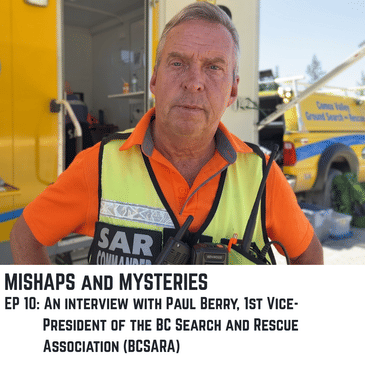
Search and rescue in British Columbia is a massive, always-on effort, and this conversation pulls back the curtain on what it really takes to keep people safe in the backcountry and beyond. We’re joined by Paul Berry, a veteran SAR leader with more than 28 years of experience, to talk about the realities of missing-person searches, volunteer burnout, modern rescue technology, and the training that goes into every operation.
This episode also revisits the Sylvia Apps search with insight from someone who helped lead the response. Paul shares what made that case so challenging, why certain searches are suspended, and how teams continue the work long after a formal search ends. For anyone who loves the outdoors—or wants to understand what happens when things go wrong—this conversation offers practical safety takeaways and a deeper appreciation for the people doing this work.
We also get into the “three T’s” of outdoor safety, the rise of drones and Artemis technology, how volunteers are recruited and trained, and why donations matter so much to local SAR teams. If you’ve ever assumed a 911 call automatically means instant rescue, this episode will change that perspective.
Key Topics
[00:00:17] - Celebrating the 10th episode and introducing the podcast’s first interview format
[00:00:35] - The scale of search and rescue in British Columbia and the role of volunteers
[00:01:11] - Guest introduction: Paul Berry, Comox Valley Ground Search and Rescue Manager
[00:02:59] - How search and rescue works across BC and who activates teams
[00:04:55] - Burnout, increasing call volume, and year-round demand on SAR teams
[00:06:11] - Outdoor safety advice: training, trip planning, and essentials
[00:08:51] - Paul’s perspective on the Sylvia Apps search
[00:12:47] - How and when a search is stood down
[00:17:36] - Search and rescue technology: drones, cell data, and Artemis airborne systems
[00:20:34] - How Paul got started in search and rescue
[00:24:08] - Team structure, specialist skills, and training requirements
[00:27:30] - Applying to SAR teams and how volunteer intake works
[00:28:45] - Donations, funding gaps, and why community support matters
Relevant Links
Adventure Smart: https://adventuresmart.ca/
Comox Valley Ground Search and Rescue: https://cvgsar.com/
BC Search and Rescue Association: https://bcsara.com/
Justice Institute of British Columbia: https://www.jibc.ca/
Paul’s stories make one thing clear: search and rescue is powered by skill, preparation, and a remarkable amount of dedication. The episode closes with a reminder that outdoor safety starts long before anyone is missing—and that staying informed can make all the difference.
If you want to support SAR work, consider donating, volunteering, or sharing outdoor safety resources with someone heading into the backcountry.
[00:00:00] - [Nina]
Welcome to mishaps and mysteries. I'm your host, Nina.
[00:00:03] - [Cassie]
And I'm your host, Cassie.
[00:00:06] - [Nina]
Our podcast explores stories of misadventures in the wild landscapes of British Columbia, Canada. Thanks for being here with us today.
[00:00:17] - [Cassie]
Today is a very special day. We're celebrating our tenth episode. And to mark the occasion, we're doing something different. We're pleased to be sharing our first interview episode with all of you. Our stories all share the common denominator of a search.
[00:00:35] - [Cassie]
The outcomes are different story to story, but behind every case, there are real people out there combing the wild landscapes in the hopes of finding the missing person or people. In DC, there are 78 search and rescue organizations across the province with 2,500 volunteers. It's a huge commitment for anyone involved, and they do it out of a passion for helping. Volunteers need to stay physically fit, do loads of training, and be on call. They risk their lives with some calls.
[00:01:11] - [Nina]
Those of you who have been with us here since the first episode will recognize the name of our guest today. When Sylvia Apps went missing in 2014, our guest was leading the charge of the ground search and rescue efforts. In interviews, he shared how mystified he was by the circumstances surrounding the search. He's the Comox Valley Ground Search and Rescue Manager, the first vice president of BC's Search and Rescue Association, and he teaches leadership and search management across the province through the Justice Institute and instructs on lost person behavior and incident command. We are pleased to introduce Paul Berry.
[00:01:51] - [Nina]
Paul, welcome to mishaps and mysteries.
[00:01:53] - [Paul Berry, 1st Vice - President of BCSARA]
Thank you. It's a pleasure to be here this evening.
[00:01:59] - [Cassie]
Paul, with your resume, my first question is, how do you find the time?
[00:02:04] - [Paul Berry, 1st Vice - President of BCSARA]
Well, I've been involved for over twenty eight years. Most of that time employed as a school principal and a district administrator here in Comox Valley. I was very fortunate to have an employer who was very supportive of my work. And certainly when we had large, multi day operations, if I could share the search with with my work, they prevented that. Otherwise, it's it's a significant number of hours that you put in, each week and each month and each year on evenings and weekends to, to maintain your training and to work alongside your your teammates.
[00:02:45] - [Paul Berry, 1st Vice - President of BCSARA]
Currently, I am retired from the school district, but I'm working at a number of other locations all in the emergency management field.
[00:02:53] - [Nina]
Paul, can you tell us about search and rescue, and how does it work in the province?
[00:02:59] - [Paul Berry, 1st Vice - President of BCSARA]
Search and rescue is a provincial responsibility, and it is, for the most part, a missing person is a missing person's investigation, which falls under the police or jurisdiction. And in in many cases, it is the RCMP. But where you have a municipal police force, it is that municipal police force who is responsible for organizing the investigation and search for that missing person. Teams are activated through the emergency coordination center located in Victoria. It's a branch of emergency management and climate response, and they activate all 78 teams twenty four hours a day, seven days a week, three sixty five days a year.
[00:03:41] - [Paul Berry, 1st Vice - President of BCSARA]
And our teams not only respond to searches, in wilderness, but in urban environments as well for lost and missing children, for elderly with dementia, with other chronic conditions that may have them wandering from their homes or from the institutions that they might be in. And then we assist civil authorities, the wildfires this past summer. Over the last few years, the wildfires have really taxed search and rescue teams, who are involved in conducting all of the, or many of the evacuations, and that can take place over many days. Very taxing on the teams. And then we respond to to support BC Ambulance with medical response where BC Ambulance cannot reach that subject.
[00:04:32] - [Nina]
I feel like burnout is a real thing, Paul. Every you know, I just I was just reading about the Kennedy Lake, the fellow in the canoe who was rescued on I guess he was lost on Sunday. And it just seems like like every week, the search and rescue folks are out. So how how do they manage burnout?
[00:04:55] - [Paul Berry, 1st Vice - President of BCSARA]
It it it could be a significant issue, and the the reality is that the volume of calls for search and rescue teams across the province has grown exponentially over the last ten years. BC, teams conduct more operations than the rest of Canada combined. And for some teams, that means that they are activated multiple times in a single day, particularly through the the the summer season. But certainly, my experience has been that we have we're busy all year long now. There's not just a busy hiking season.
[00:05:28] - [Paul Berry, 1st Vice - President of BCSARA]
People are more active, which is a positive thing. But as a result of technology, things like e bikes, people can go further and and they rely on their technology. And sometimes technology lets us down and creates a bigger challenge.
[00:05:44] - [Nina]
Yeah. Interesting. I I didn't even think about the impact technology would have on search and rescue in that sense. Right. Yeah.
[00:05:51] - [Nina]
That people can go further.
[00:05:55] - [Cassie]
This leads into another question that we have, which is, as you said, there's an increase in calls province wide, and then our province also has just a lot of calls. So what are the top three things that you would like our audience to know most about outdoor safety?
[00:06:11] - [Paul Berry, 1st Vice - President of BCSARA]
I would encourage absolutely everyone who is venturing out, whether they're in a, urban park or they're heading into the backcountry. To take a look at the adventuresmart.ca website, adventure smart is the prevention wing of search and rescue, across Canada, and it has an abundance of resources that every single person can learn from. It really talks about three key things, training, and that's ensuring that you have the right training to engage in the activity that you wish to engage in. Trip planning, which means studying the weather, studying the conditions that you're going to travel along, and leaving a plan that is a detailed plan of when you're leaving, where you're where you're starting from, where you intend to finish, what your campsites might be, equipment and things that you have with you, and then the essentials. What are the essentials that that people need to take with them to ensure that they can look after themselves in the event that they're delayed or injured?
[00:07:19] - [Paul Berry, 1st Vice - President of BCSARA]
Many people believe that, when something goes wrong, you can pick up your cell phone and dial 911 and magically, a helicopter is going to descend and and help you. But the reality is that many of the operations that take place across this province require hours of access. If it start, if the weather has closed in, teams are not gonna be accessing it very quickly. They're gonna be on foot and hiking in to to locate you first to locate you and then to help you. And so those those three t's, the training, the trip planning, and taking the essentials.
[00:07:53] - [Paul Berry, 1st Vice - President of BCSARA]
The essentials include food, water, sunscreen if we're talking about summer, proper change of clothing, flashlight, a signaling device that that will work when cell signal no longer exists, extra batteries for those electronics that we all rely upon. Certainly, there is a significant pattern in all of the operations that that we're involved in, and it's usually when we if we are able to speak to the lost or injured individual, the first thing they tell us is that they have 5% left on their cell phone.
[00:08:30] - [Cassie]
Paul, our our very first episode was about Sylvia Apps. And she was an inspiration to us just like her history as she was such an avid outdoors woman. And as as far as we know, Sylvia, she did everything right. And so we just wonder if you can give us some insights into the search and your thoughts on the case of Sylvia.
[00:08:51] - [Paul Berry, 1st Vice - President of BCSARA]
Certainly. The the search for Sylvia is one that rests heavily on all of us who were involved in that search, and and there were many. Because Sylvia was so well known for the work that she and her husband had had done in creating and maintaining so many of the trails in Strathcona Park. She knew that that countryside inside and out. And so when she failed to return, there was one, there was a huge number of of the searchers who knew both her and her husband quite well, knew what her capabilities were.
[00:09:32] - [Paul Berry, 1st Vice - President of BCSARA]
And and so there was a, as there always is, a high sense of urgency to create a search and build that search up quickly to try to locate her because the conditions were quite warm at that time. And Sylvia wasn't young on that solo trip. Quite quickly, we located Sylvia's backpack on the trail near her intended route, and we learned that she had a practice of putting her pack down when she was going to go off and explore or take photographs and leaving it close on a trail allowed her to relocate it. Despite significant air, ground, canine resources, Sicily was not located quickly, and so the the search expanded from a few local teams, Comox, taking the lead, but Parksville, so Arrowsmith Search and Rescue and Camel Research and Rescue were on the scene very quickly as well, as well as, RCP, K9 Resources, and Search and Rescue, Canines as well. And we were very quickly able to locate many, many of the items that Sylvia had taken with her, but were unable to locate her.
[00:10:47] - [Paul Berry, 1st Vice - President of BCSARA]
We did interview pair of hikers who had spoken with or observed Sylvia traveling close to where her backpack was, and they described her as being head down, quite focused, didn't didn't speak to them particularly, but Sylvia was known to be quite introverted. And, so they they didn't think much of it, but it helped us locate her on the mountain in close proximity to where she said she had been, and that allowed us to do further search and locate all those other other items. We know that she was an avid photographer. We believe she was taking photographs of the there was a very significant full moon the night that she disappeared and may have had some sort of medical event or injured herself in and around where we found many of these items. And then the search went on for seven operational periods, 22 search and rescue teams from throughout the province over that period of time, and, no further trace of her throughout throughout all of that those operations.
[00:11:56] - [Paul Berry, 1st Vice - President of BCSARA]
The days were long. Multiple helicopters, some days as many as eight helicopters lifting teams from the Ravens Lodge area of Mount Washington into the Alpine covered many, many thousands of square kilometers both by air and ground to no avail. So and and no sign or no other clues have, come to light since that time.
[00:12:18] - [Nina]
Yeah. That that's sort of the reason we decided that we needed to talk about Sylvia Epps, on that first episode, and it was around her her anniversary. And we do still follow some Facebook groups that still still talk about that and still discuss it.
[00:12:33] - [Paul Berry, 1st Vice - President of BCSARA]
Yeah. I know the Comoros Valley mount mountaineering club when when they're hiking, they're they're looking for any sign as as are many of our team who recreate in in the park.
[00:12:47] - [Nina]
Why don't we chat a little bit and cast about the criteria used to stand down a search?
[00:12:54] - [Paul Berry, 1st Vice - President of BCSARA]
Yeah. Search suspension. Certainly, every every researcher, every morning when we set out, they have a belief in their minds and in their hearts that they will find something that helps us lead them to or lead us to the location of of the individual that we're searching. That that's one of the, I think, key and most positive attributes of of SAR members across the province is is their their hope and hard work and the dedication they have to trying to locate that individual. But they always do it against the backdrop of knowing that we are incredibly insignificant against the backdrop of the terrain, the geography of this province.
[00:13:45] - [Paul Berry, 1st Vice - President of BCSARA]
And so when when we go missing, we are a needle in a very, very large haystack. In terms of pending a search, there are there are a number of criteria, and and some searches can go on for very long periods of time if the weather conditions determine that survivability could be for a long period of time. If we believe that that individual was well prepared, that had equipment and and supplies with them that could sustain them over a long period of time. When weather conditions are extremely poor and, hazards are very high, then searches can be, much shorter in duration. And there are times when searches are suspended because the risk is too high for the searchers.
[00:14:37] - [Paul Berry, 1st Vice - President of BCSARA]
And and then they can be reactivated at a time when conditions improve. Avalanche search is a is a good example, but severe weather conditions that would pose challenges for teams traveling through terrain or for, you know, high water, all those sorts of things can can slow a search down. But for the survivability, the trainings, the level of equipment that that individual had with them, all factor into it. And and every single day that a search goes on, the the search team and the police or jurisdiction will meet with family and talk to them, show them the maps that describe the story of that search, where we where we've covered what strategies, what tools, what technology we've used, people, dogs, trackers, drones, helicopters, infrared, all of that is shared with them so that they can see the full scope of the work that has been undertaken. And over the days that just builds and builds and builds, and very often you will have family members, particularly when conditions are poor or they know that maybe medical conditions exist within with their family member, they'll start to ask questions about what happens if they are not located.
[00:15:53] - [Paul Berry, 1st Vice - President of BCSARA]
That always makes the the conversation easier, but not easy by any stretch of the imagination. And so the when we have shared all that information, when we looked, everywhere that we can look based on the science that we we use, and and there's considerable science in lost person behavior about how to conduct a search, how thorough that search needs to be before we believe we have enough coverage to say that that individual is not in the area or that their survivability has passed a a period of time and that very unlikely, to be located or to have survived, then that search is called off. But they're never completely called off. The the formal ground search may be ceased, but both because it becomes an open missing person's investigation and other, more passive tools are used. Signage can be put up in a park to say, you know, this person is missing.
[00:16:54] - [Paul Berry, 1st Vice - President of BCSARA]
If you see anything, you know, a packed piece of clothing that may they might have had, all those sorts of things are done. Social media is is a huge tool in this day and age to keep that search ongoing for many, many years.
[00:17:08] - [Nina]
Yeah. And and it seems too that family members will continue to search.
[00:17:13] - [Paul Berry, 1st Vice - President of BCSARA]
Very often.
[00:17:13] - [Cassie]
Yeah. We definitely read about that in the stories that we're covering. Yeah. I can't imagine it's easy to stand down a search.
[00:17:24] - [Nina]
You answered a lot of questions about new advances in search and rescue technology when you were when you were answering that question. Is there anything that you haven't mentioned? What about the Artemis?
[00:17:36] - [Paul Berry, 1st Vice - President of BCSARA]
Mhmm. Sure. I I like to say that in in the time that I've been a member so things have have changed dramatically. Very little of the technology we use today existed twenty eight years ago. We were using paper based maps, old generation GPS, or just mapping compass.
[00:17:56] - [Paul Berry, 1st Vice - President of BCSARA]
And today, we have a whole suite of of amazing equipment that allows us to scan terrain and and cover much, much more ground. So drones drones can provide us visual imagery, both daytime and nighttime. At nighttime, it's with infrared technology during the daytime, depending on the software we're using along with those drones, we can input you know, the the drones will be looking for targets of a particular color, particular size. And as those targets may be viewed or items that might fit that criteria were were made aware of that. So those targets then, get to be explored.
[00:18:38] - [Paul Berry, 1st Vice - President of BCSARA]
But but cell phones are a a huge tool that one most people carry on. Cell phones, if people are using their location software, can provide us a number of very good tools to allow us to locate someone quickly. Our team, for example, if if Cassandra was lost and couldn't find her way, we can text her phone and her phone will give us her exact location on When a we can't have that direct communications and direct location data. Then we do have other tools, and Artemis is airborne technology that both the military and PEP Air, which is the volunteer search and rescue division that flies. They have aircraft that contain the Artemis tool, which really is like a flying cell tower.
[00:19:39] - [Paul Berry, 1st Vice - President of BCSARA]
If, you can call up to the Artemis device or they can call down directly to you. But more specifically, RTMP can receive specific data about your phone, two particular numbers. And if those numbers are entered into the Artemis, we can directly locate a single phone out of hundreds that might be within a search area, giving us a precise location of at least where the phone is.
[00:20:12] - [Nina]
That's amazing.
[00:20:13] - [Paul Berry, 1st Vice - President of BCSARA]
Now all of this technology only works as long as the battery still has power.
[00:20:18] - [Nina]
Right. Right. Yeah.
[00:20:19] - [Cassie]
Yeah. Right. So always keep a charge. Mhmm. Switching gears a bit, Paul.
[00:20:28] - [Cassie]
So you mentioned twenty eight years ago, you got into search and rescue. Tell us how that happened.
[00:20:34] - [Paul Berry, 1st Vice - President of BCSARA]
I was working as a as a school principal here in the the Comox Valley and, was was wanting to do something to give back to the community outside of the work I was doing in schools and had the opportunity to meet. I was actually in a safety bear costume in August on a hot day, and and one of the SAR members at the booth next to us at a kids' fest came over and handled me a bottle of water. We started talking about the SAR team and what they they did and how they worked and and training. And a few weeks later, I went and spoke to them and and started with them at that point. But I told this story a number of times because it's still really impactful.
[00:21:23] - [Paul Berry, 1st Vice - President of BCSARA]
On the first operation that I was involved in, it was a rescue on Comox Glacier, very steep switchback trail, quite an individual who was very seriously injured, and, it had taken us a couple of hours to get up to him. We knew that he needed to get to a higher level of care very quickly. We required the support of four forty two search and rescue squadron, but the weather had closed in up on the glacier. So we put out a call for mutual aid. Mutual aid is calling your friends as many other search and rescue teams in close proximity as you can to help support you.
[00:22:02] - [Paul Berry, 1st Vice - President of BCSARA]
And I I remember distinctly working hard feverishly to cut, an area in the trees to allow the helicopter to come in and hoist this individual out if if the weather cleared. But I was I looked back down the trail that we had come up and all I could see for as far as I could see were these pinpoints of light. And it dawned on me that those pinpoints of light were men and women who had left their homes, left left their beds, left their families, and had many had driven significant distances. And they were all moving up this trail in the dark of night to help this person who they didn't know. And it just created this this sense of community in me that, exists to this day.
[00:22:58] - [Paul Berry, 1st Vice - President of BCSARA]
We were successful in in finding a break in the weather, and and this fellow was successfully airlifted off. And then we all went down the mountain together. And there's this large group, and many of them are still my good friends after twenty eight years.
[00:23:14] - [Nina]
Wow. That that's that's an amazing story. Yeah. So moving. That's so moving.
[00:23:19] - [Cassie]
I know. I'm trying not to get emotional. It's such a beautiful visual that you've provided there, and and obviously, you were just that was the ad for you. Right? Like, knew you'd be doing this for a long time to come.
[00:23:34] - [Paul Berry, 1st Vice - President of BCSARA]
Yeah. And I still get quite emotional when when we have particularly when we have a large scale search and all this community that is search and rescue joins together and work so hard, so tirelessly, and so well together, combining all the various skills that they have for one single purpose, and that's to help someone else.
[00:24:01] - [Nina]
Why don't you tell us a little bit about the team and what they're trained to do and the and the different specialists you have.
[00:24:08] - [Paul Berry, 1st Vice - President of BCSARA]
Sure. Our our team has existed for I think it's fifth three three coming up on fifty four years now. We have some members who have been on the team all of that time.
[00:24:18] - [Nina]
Wow.
[00:24:19] - [Paul Berry, 1st Vice - President of BCSARA]
We have quite a young team now, with, our last intake of of, members, and with them come a significant number of skills. Every every member of a research and rescue team, first and foremost, is a ground search and rescue technician. They all undertake eighty plus hour course over a number of months to to achieve that ground search and rescue certification. And once they have that, and that's the generic skills, search techniques, basic rope work, significant hours of first aid, map and compass, all those sorts of things that we do every time we're out in the field. But once you have that foundation, then you can specialize in many other capabilities.
[00:25:06] - [Paul Berry, 1st Vice - President of BCSARA]
And so we have a team that has very highly skilled trackers. Those are individuals who are trained for many, many weeks and years to look at the ground and to discern sign of travel. We have advanced medical team, which includes paramedics, doctors, and most of our team have probably a minimum of a forty hour first aid course, some with more, unless they have a professional certification as a as a paramedic or doctors. We have two two young doctors who specialize in wilderness medicine and emergency medicine who have been an amazing addendum to our team. Rope technical rope rescue is another rescue capability that we possess.
[00:25:53] - [Paul Berry, 1st Vice - President of BCSARA]
Helicopter long line rescue. So this is where you don't get to fly in the helicopter. You're actually suspended on a line beneath the helicopter to be inserted or to help extract an individual. Swiftwater rescue, avalanche rescue, and mountain rescue. And and the recent search that we conducted in Strathcona Park, involved a significant number of mountain rescue personnel.
[00:26:19] - [Paul Berry, 1st Vice - President of BCSARA]
In addition, we have members who no longer deploy into the field, but they are absolutely vital in maintaining our equipment, ensuring our that our supplies are constantly upgraded. So in operation the other night, we went through lots of batteries and headlamps and things like that. So they're making sure that those are replenished right away so that we are constantly operational. And then there's just the basic maintenance of our fleet of equipment, Sea Doos and all terrain vehicles and trucks and trailers, plus the building. All of that is involved in maintaining our operational readiness all the time.
[00:27:02] - [Paul Berry, 1st Vice - President of BCSARA]
And then all of us are involved in a constant fundraising process to ensure that we have the dollars continue to train, to continue to improve our skill sets, and to continue to maintain and upgrade the equipment we have so that we can do the best possible job.
[00:27:20] - [Nina]
That sounds great. Is there a certain time of year that you do intake, or do you accept new members throughout throughout the year?
[00:27:30] - [Paul Berry, 1st Vice - President of BCSARA]
We we have a waiting list right now and are not taking new members because we we currently hold about 60 members on our roster, and that seems to be a sufficient number to meet our operational demands at this point. But and we we will take members who come to us that already have their GSAR certification. So we we tend to be a team that has a lot of people moving into the valley that already have their GSAR qualifications. So for them, it it an interview process and a period of probation while they join the team. But I I would say within the next year or so, we will be looking at doing another intake.
[00:28:15] - [Cassie]
So for our our listeners across the province in different jurisdictions, is it the same sort of process to go about applying no matter where you are?
[00:28:25] - [Paul Berry, 1st Vice - President of BCSARA]
Certainly, all all teams will have an info, page on their their website that will talk about how to apply if they are interested in in being a member of a search and rescue team.
[00:28:39] - [Cassie]
Where can our listeners donate to Comox Valley Search and Rescue, and how do donations help?
[00:28:45] - [Paul Berry, 1st Vice - President of BCSARA]
Team's website is, cvgsar.com. And on that page, there is, there's an information link if you're interested in knowing more about the team, but there is also a donate button that you can donate to the team. All teams in BC are nonprofit societies. So in in addition to the the many, many hundreds of hours of training and operations that we're committed to, will probably have an equal number of hours that are devoted to, fundraising. And those funds help replace equipment.
[00:29:20] - [Paul Berry, 1st Vice - President of BCSARA]
All of the equipment that we we use has a shelf life, Climbing equipment, harnesses, ropes, PFDs all have a manufacturer's life to them. So every five years, ropes are replaced, helmets are replaced, harnesses are replaced, PFDs are replaced, and that's ongoing costs. We do receive funding from the province of BC, about $90,000 a year, but the funding that search and rescue in the province provides is about 50¢ on the dollar for the operation of a SAR team. And so every team is involved in applying for grants and for looking for other avenues to, sustain the operations that they engage in. And like everything else, everything is becoming more expensive.
[00:30:11] - [Cassie]
Yeah. I imagine $90,000 doesn't go very far for your operations.
[00:30:17] - [Paul Berry, 1st Vice - President of BCSARA]
No. Not when you look at I mean, we have a a building. We have a significant fleet of emergency vehicles, large command vehicle, plus all the technology and the technology is changing so rapidly that, we're constantly upgrading to make sure that we have the best possible tools to assist us. And certainly right now, expanding our drone technology has been a is a significant undertaking, but every member has to requalify for helicopter operations every year. Helicopters run about $4,000 an hour.
[00:30:54] - [Paul Berry, 1st Vice - President of BCSARA]
And so big expenditure when you're training 60 people over the course of a day for helicopter operations. And then we have our long line rescue team as well for helicopters. So that's additional money. It adds up very, very rapidly.
[00:31:10] - [Cassie]
Well, miss Huffs and Mysteries will be making a donation, and we would encourage our listeners to do the same. We're also hoping to hold a fundraiser soon. So if you are one of our listeners on Vancouver Island, please stay tuned. Paul, thank you so much for joining us. It has been such an honor to talk to you, and I feel like we have learned so much tonight.
[00:31:31] - [Cassie]
We really are just so appreciative of the work that you and your team does and the teams across the province. We absolutely love learning about just just the work that everyone puts in. It's such an important part of, the stories that we tell. Again, thank you for being on. You are such an inspiration to many people.
[00:31:51] - [Cassie]
The fact that you took the time to be on our little podcast really means a lot.
[00:31:55] - [Paul Berry, 1st Vice - President of BCSARA]
Thank you very much, and and certainly we appreciate you keeping the stories of these missing people alive so that maybe one day something that has been heard on on this podcast will lead to a resolution.
[00:32:12] - [Cassie]
Thank you.
[00:32:12] - [Speaker 2]
Thank you.
[00:32:13] - [Cassie]
Thank you so much. Thank you. Thanks for joining us this episode. You can reach out to us at info@mishapsandmysteries.ca
[00:32:22] - [Cassie]
If you enjoyed this episode, please subscribe and leave us a rating and a review. It really helps new people find us. Be safe and never stop exploring.