
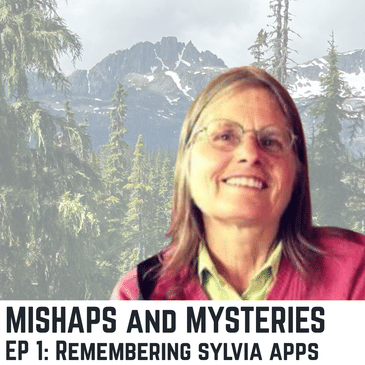
In July 2014, Sylvia Apps, an amazing woman and highly experienced hiker, set out on a 5 day solo backpacking trip in Strathcona Provincial Park on Vancouver Island. She did not return when expected and searches were initiated… but what searchers do find leaves them with more questions than answers. Twelve years later, many remain mystified as to what happened to Sylvia.
Content Warning: No content warnings
Of Particular Interest:
Remembering Don and Sylvia Apps
Comox Valley Ground Search and Rescue
Sources:
News Articles:
Search for Missing Hiker Sylvia Apps Baffles Searchers in Stratchona Park | CBC News
Search for Sylvia Apps Formally Stood Down | My Comox Valley Now
https://www.mycomoxvalleynow.com/1035/news/search-for-sylvia-apps-formally-stood-down/
Search and Rescue Crews Looking for Comox Valley Hiker Missing Since July 8 | Global News
Hiker’s iPhone and Other Items Recovered | Campbell River Mirror
https://campbellrivermirror.com/2014/07/18/hikers-iphone-other-items-recovered/
Other:
The baffling disappearance of Sylvia Apps from Strathcona Provincial Park | Strange Outdoors Blog
https://www.strangeoutdoors.com/mysterious-stories-blog/2017/11/28/sylvia-apps
Remembering Don and Sylvia Apps | Submitted by William Wright to My Comox Valley Record
https://comoxvalleyrecord.com/2015/06/13/remembering-don-sylvia-apps/
Castlecrag Mountain on AllTrails
Mt Apps | Summit Post
https://www.summitpost.org/mt-apps/920823
Strathcona Provincial Park | Wikipedia
https://en.wikipedia.org/wiki/Strathcona_Provincial_Park
Geology of Strathcona Provincial Park | British Columbia Geological Survey
Karmutsen Formation | Wikipedia
https://en.wikipedia.org/wiki/Karmutsen_Formation
Youtube videos:
Missing Hiker Strathcona Park, Backpack, Gear, Phone, Found in All different Areas of the Park.| Bryan’s Mysteries and Adventures on Trail
https://www.youtube.com/watch?v=HFwIT8L6iKg&list=TLPQMTExMjIwMjQuxGbU9vtlEg&index=5&pp=gAQBiAQB
National Park Rangers Find This On A Hiking Trail But Then Discover That Something Went Wrong | Unexplained Mysteries
https://www.youtube.com/watch?v=lYR6MetqKwY&list=TLPQMTcxMjIwMjQg1LwtLdZyrg&index=7
Missing 411 - The Strathcona Park Disappearances, Vancouver Island, British Columbia, Canada | Canam Missing Project
https://www.youtube.com/watch?v=CTtKSRHSJjM&t=1s (last part of video - 22:55)
[00:00:00] - [Speaker 0]
Welcome to the mishaps and mysteries podcast. British Columbia, Canada has a far greater number of missing persons than the national average each year. One reason, BC is a province of great landscapes. From the beautiful Rocky Mountains to the desert region of the Okanagan, the coastlines and rainforests in the West, and so much more. BC is an outdoor adventurer's paradise.
[00:00:28] - [Speaker 0]
But when things go wrong, that wild beauty can turn into harsh reality. Remote and rugged landscapes make for easy accidents, difficult search and rescue efforts, and ideal places for nefarious and strange occurrences, and for secrets to stay hidden.
[00:00:47] - [Speaker 1]
We're friends that love exploring the great outdoors, listening to podcasts, and discussing mysteries and true crime. We were inspired by cases of missing persons in the backcountry of BC and decided to start a podcast focusing on the local stories of those who have gone missing in our beautiful and vast province of British Columbia, Canada. Some survived, some were eventually found deceased, and some remained on, leaving us with more questions than answers.
[00:01:17] - [Speaker 0]
Our case studies have a common thread. They happened in the wild in the spaces in between. We've got stories of outdoor adventures and activities gone wrong, mysteries from way up dirt roads and out to sea. Where applicable, we interview survivors, learn from those still looking for their loved ones, or go over tips for outdoor safety. Because we want you to be safe and never stop exploring.
[00:01:45] - [Speaker 1]
So if you're into these kinds of discussions, please listen along. Share with your friends and follow us on our socials to join the conversation. If you're here for the very first episode, then you're probably one of our loved ones. Thanks for supporting us. Now let's get into the first story.
[00:02:03] - [Speaker 0]
Imagine, you have been a search and rescue manager for nearly two and a half decades, and one summer you are called to a missing person search that you later go on to describe in interviews as mystifying. Welcome to episode one, remembering Sylvia Apps.
[00:02:30] - [Speaker 1]
I was recently in this area on a backpacking adventure, and I noticed many young people. A whole generation of outdoor enthusiasts off to explore Strathcona Park. I wondered how many knew of Sylvia Apps and what had happened here twelve years ago on Castle Craig Mountain. This case remains the only instance in Vancouver Island search and rescue history where all personal items were retrieved without the missing person.
[00:02:56] - [Speaker 0]
This one is close to home for us. As we move about our lives, the mountains of Strathcona Park are visible. We've each had many adventures out there. Often when I gaze at the mountain peaks, I think of Sylvia.
[00:03:11] - [Speaker 1]
Cass, I feel like we owe it to Sylvia to try to keep her memory alive. There's an increase in visitors to Strathcona Park, which can lead to a false sense of security and safety. There's a very important lesson here in this tragedy. Sylvia was experienced and prepared and yet something terrible happened.
[00:03:30] - [Speaker 0]
It's because of the type of woman Sylvia was and the location of this story that this one is a case that sticks with us. So it was an inspiration for the podcast and a clear choice for episode one. Not only that, but we are releasing this episode on the twelve year anniversary of the week of Sylvia's disappearance so that we can bring attention to the story for those who may be out in the same backcountry this summer. Let us tell you about Sylvia. When she disappeared in 2014, Sylvia was 69 years old, which would make her 81 today.
[00:04:10] - [Speaker 0]
She was everything I wanna be at that age. This woman knew her stuff and was an avid hiker and outdoors woman. Very experienced and she was incredibly fit. She could hike 20 kilometers per day. She was also very smart and described as modest and unassuming.
[00:04:29] - [Speaker 1]
Sylvia was married to Dawn Epps for over thirty years and had three sons. Dawn passed away in 2011, so prior to her disappearance. He was also an avid outdoorsman and a well known mountaineer. Here's a few interesting facts our listeners might not be aware of. The Seal Bay Nature Park in the Comox Valley has a trail named after him.
[00:04:51] - [Speaker 1]
Mount Apps in the Beaufort Range gets its name from him, and he developed the Arnica Lake Trail to Phillips Ridge and the Golden Hind, which is Vancouver Island's highest mountain. Sylvia and Don met in the late nineteen sixties on a backpacking trip to the Cape Scott Lighthouse on Northern Vancouver Island. Dawn and Sylvia loved Strathcona Park so much that they gave up their careers in Victoria to move to Comox Valley to be closer to the park. There's a really good article by William Wright titled remembering Dawn and Sylvia apps that speaks to them as a couple. You can find a link in our show notes.
[00:05:30] - [Speaker 0]
So to say the least, Sylvia and Dawn were serious about the outdoors, and especially their locals Jathcona Park Mountains. They lived in Courtney, which is just about a thirty to forty minute drive from the trailhead of where Sylvia's disappearance took place. Sylvia knew this area better than most of us and was well prepared. Let's set the scene. On 07/08/2014, Sylvia Apps, an experienced hiker, embarked on a five day solo trip in Strathcona Park on Vancouver Island.
[00:06:03] - [Speaker 0]
Strathcona Park is the oldest provincial park in BC, established in 1911. At over 2,400 square kilometers, the park is a rugged and vast wilderness. It's an outdoor lovers playground. It includes campgrounds, backpacking routes, Vancouver Island's highest mountains, waterfalls, including the highest waterfall in Canada, Della Falls, which you and
[00:06:29] - [Speaker 1]
I backpacked to a few years ago. Yep. We sure did. Sylvia was traveling to Castle Craig Mountain in the park. The most common way to get to Castle Craig is to first hike to the camp at Cirquit Lake Campground, which is about a three to five hour hike from Paradise Menno's parking lot.
[00:06:48] - [Speaker 1]
Then from Circlet Lake Campground, the hike to Castle Craig Mountain is 13.7 kilometers round trip with a nearly 900 meter elevation gain. It's a difficult trail, and Sylvia's plan for a five day hike was a reasonable pace for her hikes. So now let's talk about the equipment Sylvia had. This is important to the story. Sylvia employed multiple fail safes and carried high quality gear.
[00:07:16] - [Speaker 1]
For navigation, she had dedicated maps and navigation tools. She had a dual phone strategy. She carried two mobile phones, a primary and a backup. And at that time, much of the park was out of cell range. For gear, she had a blue backpack containing full supplies, trekking poles, and a camera.
[00:07:37] - [Speaker 0]
Great. Thanks for that breakdown. But July 13 comes, five days after the start of her trip. And the very prepared Sylvia, she hasn't reached out to her family and friends who are expecting her return by now. And as per Sylvia's plan, they did not hesitate.
[00:07:55] - [Speaker 0]
They called for search and rescue.
[00:07:58] - [Speaker 1]
Okay. Let's talk about this location, Gasp. As we've said, this is an area with challenging terrain. Three other people have disappeared in the same general area of Strathcona Park. They were Duane Bressler, Richard Milner, and Lawrence Phillipson.
[00:08:13] - [Speaker 1]
These are all cases we'll cover later. Hoboks Valley Ground Search And Rescue mobilized over 175 people the first day of the search, including a 119 searchers and 54 volunteers from 19 different provincial teams. At its peak, the search had over 200 volunteers. Verticalities south of Castle Creek required helicopter supported searches. Three helicopters were used.
[00:08:41] - [Speaker 1]
Specialized rope teams conducted vertical descents from above, while mountain rescue units navigated the snowfields and crevices below.
[00:08:50] - [Speaker 0]
And yet, despite all that, they just couldn't find Sylvia. They did however, find her things. Here's what we know about what was found. The blue backpack. Recovered during the second week of July, it was found in good condition, containing nearly all supplies.
[00:09:13] - [Speaker 0]
This suggests that the pack was set down intentionally rather than lost during a traumatic fall. Her trekking poles and camera. These primary items were found in locations distinct and separated from the backpack. And finally, her mobile devices. Search and rescue recovered her iPhone.
[00:09:34] - [Speaker 0]
While it contained photos from early in the trip, that was all the information it provided. There is an explicit mention of the backup phone. Presumably, that was found in her pack.
[00:09:46] - [Speaker 1]
Paul Berry, the president and search manager of Comox Valley Grounds Search and Rescue, described the case as very mystifying. After an extensive search, the official search and rescue operation was scaled back. It was the first time in mister Barrett's career that he had never found someone but found their belongings in such a condition. After about a week, operations ceased as search and rescue knew that the chances of survival in the heat and extreme terrain and without her supplies were low. So the search was called off on July 20 about a week after Sylvia was reported missing.
[00:10:24] - [Speaker 1]
Let's discuss some of the reasons why. These included technical challenges of terrain. So the the verticality, the snow fields, the drainages. And let's talk about the extreme technical obstacles. So first, there's the terrain hazards.
[00:10:43] - [Speaker 1]
The area South of Castle Craig is characterized by vertical drop offs and small crevasses. The geology creates unstable vertical terrain that could easily conceal a subject from both aerial and ground observation. There's also the survivability window. During the operation, the region experienced extreme heat. Search and rescue analysts determined that Sylvia's separation from her water and gear, which was found in her backpack, effectively closed the survivability window within seventy two to ninety six hours.
[00:11:22] - [Speaker 1]
Then there were search limitations. On July 20, the search was stopped. The risk to benefit ratio didn't make sense with the dwindling probability of search and rescue being able to find Sylvia after the extent of the search and the closing of the survivability window.
[00:11:41] - [Speaker 0]
Let's go over the timeline of events here to paint the best picture for you. On 07/08/2014, she started her hike at 11AM from Paradise Meadows on Mount Washington. She was setting out for a five day solo trek. We know that Sylvia made the summit because she signed to the register at Castle Craig Mountain on July 10, so two days later. July 11 was the last confirmed sighting of Sylvia, south of Castle Craig Mountain.
[00:12:17] - [Speaker 0]
July 13 at 4PM, as per Sylvia's plan, when she didn't check-in, family and friends reported her missing and search and rescue was activated. Between July fourteenth and nineteenth, there was the discovery of the backpack, trekking poles, and backup phone in different locations. And finally, as Nina said, on July 20, the official search and rescue operations were stood down.
[00:12:45] - [Speaker 1]
Cass, let's talk about the three main theories of Sylvia's disappearance. The first is the predator theory, where a mountain lion attack was considered but deemed improbable. There was a complete lack of biological evidence. There wasn't any blood or shredded clothing. And the recovered gear showed no signs of predator induced trauma.
[00:13:06] - [Speaker 1]
Then there was the vertical fall theory. And while a fall is possible, the undamaged condition of the backpack found separate from the poles remains the primary counterargument. A traumatic fall usually results in gear being concentrated or significantly damaged. We did find some information that the poles and camera were found in an area that indicated the items may have fallen down a slope. So there was consideration that she lost them one day while hiking and was looking for them in the area they fell the next day.
[00:13:41] - [Speaker 1]
And then finally, there's the medical emergency theory. Search and rescue president and search manager Paul Barry hypothesized a medical event such as a stroke or a heat stroke. This would explain the disorientation required for her to shed her survival gear and wander into a trap feature such as a drainage or crevasse without sending out a signal.
[00:14:04] - [Speaker 0]
The final theory definitely seems most likely to me too. But I want to add that I don't think it was a heat stroke, but a completely unpredictable medical event. Sylvia was highly experienced, and she certainly would have known how to prevent heat stroke. I personally have seen that sudden confusion or disorientation can come on in people who are otherwise healthy. And as fit as she was, Sylvia's age may still have been a factor here for a sudden neurological issue.
[00:14:35] - [Speaker 0]
So that's where I sit on those theories.
[00:14:38] - [Speaker 1]
One of the most puzzling aspects was finding Sylvia's gear scattered. A central mystery of this case is the scattering of personal effects, which baffles search and rescue. In standard search and rescue logic, a pristine item is more concerning than a damaged one. Separation of undamaged gear contradicts what you would typically expect to see. Why were these items apart?
[00:15:01] - [Speaker 1]
This phase yielded items that suggested a roller coaster of leads pushing towards disorientation or the intentional shedding of gear, which often is seen in cases of hypothermia or severe heat stroke. If Sylvia had fallen, how did her articles end up in different places? The gear was in good condition, not damaged.
[00:15:25] - [Speaker 0]
Sylvia was known to be tough and experienced. Her sons believed she might walk the 31 kilometers home rather than call for a ride. That's intense. Yet despite her experience, the recovery of her gear, and to the extensive search, no trace of Sylvia has ever been found. Sylvia App's case remains open with the RCMP, but the active search has, of course, long been suspended.
[00:15:53] - [Speaker 0]
Our thoughts go out to the family and friends of Sylvia, and we hope by sharing this case today, we keep her story out there. If you are a loved one of Sylvia and would like to share your story or join us on the podcast to talk about her, please reach out to us at info@mishapsandmysteries.ca. If you are out in the backcountry this summer, keep your eyes peeled. Especially with the lack of snowpack this year, you never know if new clues may be uncovered.
[00:16:23] - [Speaker 1]
If you have any information about Sylvia Ab's disappearance, please contact the Comox Valley RCMP at (250) 338-1321. Or you can contact the Comox Valley Crime Stoppers at 180222. That's 1802228477. Or you can contact them online at calmoxvalleycrimestoppers.bc.ca. At the end of each episode, we'll share a lesson about outdoor safety from the story.
[00:16:59] - [Speaker 1]
This one is tough, though. Sylvia did everything right, except we question why she was apart from her gear. Though given her experience, we can theorize that Sylvia did not intentionally part with her gear. If you are lost, don't separate from your gear. It contains what you need to be out in the wilderness.
[00:17:18] - [Speaker 1]
And you also never know what you could use creatively in a survival scenario. Nowadays, technology, like the two way satellite messaging devices with GPS location tracking, is much more reliable and a standard gear. However, I'm not convinced that this would have helped Sylvia. Sometimes, no matter how experienced you are or how well prepared you are, things just go very badly.
[00:17:44] - [Speaker 0]
Yeah. Totally. Sylvia was so experienced, and yet we have no answers. While it does seem that due to her experience and the evidence at hand, a medical emergency is the likely cause, the lack of answers we have provides a very unsatisfying ending to this story.
[00:18:04] - [Speaker 1]
Thanks for joining us this episode. You can reach out to us at infomishapsandmysteries. Ca. If you enjoyed this episode, please subscribe and leave us a rating and a review. It really helps new people find us.
[00:18:19] - [Speaker 1]
Be safe and never stop exploring.